


Neolepidoptera



This tree diagram shows the relationships between several groups of organisms.
The root of the current tree connects the organisms featured in this tree to their containing group and the rest of the Tree of Life. The basal branching point in the tree represents the ancestor of the other groups in the tree. This ancestor diversified over time into several descendent subgroups, which are represented as internal nodes and terminal taxa to the right.

You can click on the root to travel down the Tree of Life all the way to the root of all Life, and you can click on the names of descendent subgroups to travel up the Tree of Life all the way to individual species.
For more information on ToL tree formatting, please see Interpreting the Tree or Classification. To learn more about phylogenetic trees, please visit our Phylogenetic Biology pages.
close boxReferences
Davis, D. R. 1986. A new family of monotrysian moths from austral South America (Lepidoptera: Palaephatidae), with a phylogenetic review of the Monotrysia. Smithsonian Contributions to Zoology 434:1-202.
Davis D. R. 1999. The Monotrysian Heteroneura. Pages 65–90 in: Lepidoptera: Moths and Butterflies. 1. Evolution, Systematics, and Biogeography. Handbook of Zoology Vol. IV, Part 35. N. P. Kristensen, ed. De Gruyter, Berlin and New York.
Friedlander, T. P., J. C. Regier, C. Mitter, D. L. Wagner, and Q. Q. Fang. 2000. Evolution of heteroneuran Lepidoptera (Insecta) and the utility of dopa decarboxylase for Cretaceous-aged phylogenetics. Zoological Journal of the Linnean Society 130:213-234.
Krenn, H. W. and N. P. Kristensen. 2000. Early evolution of the proboscis of Lepidoptera (Insecta): external morphology of the galea in basal glossatan moth lineages, with remarks on the origin of the pilifers. Zoologischer Anzeiger 239:179-196.
Kristensen, N. P. 1999. The Homoneurous Glossata. Pages 51-63 in: Lepidoptera: Moths and Butterflies. 1. Evolution, Systematics, and Biogeography. Handbook of Zoology Vol. IV, Part 35. N. P. Kristensen, ed. De Gruyter, Berlin and New York.
Kristensen, N. P. and A. W. Skalski. 1999. Phylogeny and paleontology. Pages 7-25 in: Lepidoptera: Moths and Butterflies. 1. Evolution, Systematics, and Biogeography. Handbook of Zoology Vol. IV, Part 35. N. P. Kristensen, ed. De Gruyter, Berlin and New York.
Nielsen E. S. and D. R. Davis. 1985. The first southern hemisphere prodoxid and the phylogeny of the Incurvarioidea (Lepidoptera). Systematic Entomology suppl. 1:1–16.
Nielsen, E. S., G. S. Robinson, D. L. Wagner. 2000. Ghost-moths of the world: a global inventory and bibliography of the Exoporia (Mnesarchaeoidea and Hepialoidea) (Lepidoptera). Journal of Natural History 34 (6):823-878.
Scoble, M. J. 1992. The Lepidoptera: Form, Function and Diversity. Oxford: Oxford University Press.
Simonsen, T. J. 2001. The wing vestiture of the non-ditrysian Lepidoptera (Insecta). Comparative morphology and phylogenetic implications. Acta Zoologica 82(4):275-298.
Wiegmann, B. M., J. C. Regier, and C. Mitter. 2002. Combined molecular and morphological evidence on the phylogeny of the earliest lepidopteran lineages. Zoologica Scripta 31:67-81.
Title Illustrations

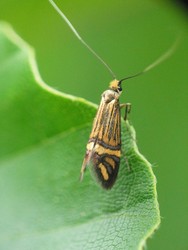
| Scientific Name | Nemophora ochsenheimerella |
|---|---|
| Location | Austria, Salzburg, Osterhorngruppe, St. Gilgen, Falkenstein, Scheffelblick |
| Comments | more info (in german) |
| Specimen Condition | Live Specimen |
| Sex | Male |
| Source | Nemophora ochsenheimerella (Hübner, 1813) |
| Source Collection | Flickr |
| Image Use |
 This media file is licensed under the Creative Commons Attribution License - Version 2.0. This media file is licensed under the Creative Commons Attribution License - Version 2.0.
|
| Copyright | © 2004 Michael Kurz |
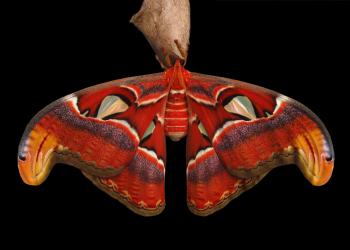
| Scientific Name | Attacus atlas |
|---|---|
| Location | captive, Tucson Botanic Gardens; origin SE Asia |
| Comments | Newly emerged specimen of the world's largest moth. |
| Identified By | David Bygott |
| Sex | Male |
| Life Cycle Stage | Adult |
| View | Dorsal |
| Copyright |
© 2005

|

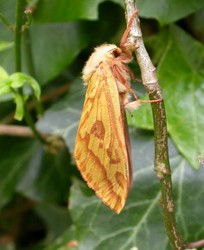
| Scientific Name | Hepialus humuli humuli |
|---|---|
| Location | Burnley, East Lancashire, UK |
| Specimen Condition | Live Specimen |
| Sex | Female |
| Source | GHOST MOTH Hepialus humuli humuli female |
| Source Collection | Flickr |
| Image Use |
This media file is licensed under the Creative Commons Attribution-NonCommercial-NoDerivs License - Version 2.0.
|
| Copyright | © 2007 Graham |
About This Page
Page copyright © 2003
 Page: Tree of Life
Neolepidoptera.
The TEXT of this page is licensed under the
Creative Commons Attribution-NonCommercial License - Version 3.0. Note that images and other media
featured on this page are each governed by their own license, and they may or may not be available
for reuse. Click on an image or a media link to access the media data window, which provides the
relevant licensing information. For the general terms and conditions of ToL material reuse and
redistribution, please see the Tree of Life Copyright
Policies.
Page: Tree of Life
Neolepidoptera.
The TEXT of this page is licensed under the
Creative Commons Attribution-NonCommercial License - Version 3.0. Note that images and other media
featured on this page are each governed by their own license, and they may or may not be available
for reuse. Click on an image or a media link to access the media data window, which provides the
relevant licensing information. For the general terms and conditions of ToL material reuse and
redistribution, please see the Tree of Life Copyright
Policies.
Citing this page:
Tree of Life Web Project. 2003. Neolepidoptera. Version 01 January 2003 (temporary). /Neolepidoptera/11719/2003.01.01 in The Tree of Life Web Project, /

