The images below show the funnel and mantle components of the "inverted T" shape locking apparatus. Note that the two shapes are complimentary allowing them to form a solid lock. The drawing on the right shows the position of the two locking components, one set on the mantle and one set on the base of the funnel.

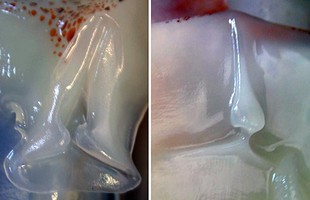

Figure. Frontal views of the funnel/mantle locking apparatus. Left - Funnel component of Illex illecebrosus. Middle - Mantle component of Illex illecebrosus. Photographs by M. Vecchione. Right - Opened mantle cavity with much of the ventral funnel removed, showing the funnel/mantle locking apparatus of Todaropsis eblanae. Drawing from Naef (1921-23).
Six general types of the funnel component exist within the "teuthoid" decapodiforms and several others within the "sepioid" decapodiforms.
| 1. Lazy-T shape. The groove in the cartilage has roughly the shape of the capital letter "T" laying on its side. This type is found only in the family Thysanoteuthidae. |  |
| 2. Inverted-T shape. The groove in the cartilage has roughly the shape of the capital letter "T" upside down. This type is found only in the family Ommastrephidae. |  |
| 3. Straight shape. The groove in the cartilage is more or less straight. This is a common shape and is found in the following families: Ancistrocheiridae, Batoteuthidae, Bathyteuthidae, Chtenopterygidae, Enoploteuthidae, Gonatidae, Histioteuthidae, Lepidoteuthidae, Loliginidae, Lycoteuthidae, Neoteuthidae, Octopoteuthidae, Onychoteuthidae, Pholidoteuthidae, Pyroteuthidae. In some squids the groove is narrow and very straight while in others the groove is rather broad and may curve slightly. |  |
| 4. Triangular shape. The groove in the cartilage has roughly the shape of a triangle. This shape is found only in the family Cycloteuthidae. |  |
| 5. Oval with tragus and /or antitragus. The groove in the cartilage has roughly an oval shape with lateral (tragus) and/or posterior (antitragus) bumps impinging on the depression. This shape is found in most members of the Chiroteuthidae and Mastigoteuthidae. Various modifications of the size, shape and position of the tragus and antitragus can greatly effect the appearance of the cartilage. For example, in some Mastigoteuthis the tragus and antitragus impinge on the oval depression anteriorly yielding a flask-shaped depression. |  |
| 6. Oval shape. The groove in the cartilage has roughly an oval shape. This shape is found in the Joubiniteuthidae, Magnapinnidae, Promachoteuthidae some Mastigoteuthidae (i.e., Mastigopsis hjorti). |  |
| 7. Boomerang shape. The groove in the cartilage varies between slightly curved to a strong boomerang shape. This shape is found in the Sepiidae. |  |
| 8. Keyhole shape. The groove consists of two distinct portions: an anterior deep, oval depression and a posterior, elongate groove with a more shallow depression. This shape is found in Sepioloidea of the Sepiolida; the latter shows considerable variability. |  |
Comments.
More information on the Funnel lock can be found on the Mantle-lock page.
Illustrations are modified from: Roper, C. F. E., R. E. Young and G. L. Voss (1969). An illustrated key to the families of the order Teuthoidea. Smiths. contr. zool., 13:1-32.


