Fin sizes: Fins of decapodiforms very greatly in both length and width. Fin lengths range from over 100% of the ML to less than 10% of the ML. We arbitrarily define «long» fins as more than 75% of the ML and «short» fins as less than 25% of the ML. In the figure below, "A" has short fins and the others have long fins. Most squids have fins of intermediate size. Some squids (not shown) have fins posterior to the muscular mantle.

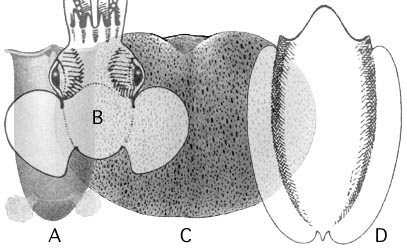
Figure. Dorsal views of fins and mantles. A - Bathothauma lyromma (Fam. Cranchiidae), modified from Chun, 1910. B - Iridoteuthis iris (Fam. Sepiolidae), modified from Naef, 1921-23. C - Discoteuthis laciniosa (Fam. Cycloteuthidae), modified from Young and Roper, 1969. D - Sepia orbignyana (Fam. Sepiidae), modified from Naef, 1921-23. All views are dorsal.
Fin shapes: Shapes are difficult to define as the shape of some fins bridge the gaps between standard shapes. Use these definitions cautiously.
Sagittate fins
Sagittate fins are probably the most common shape found in squids. These fins have anterior free fin-lobes, a relatively sharp lateral angle and posterior elongate fin with a concave posterolateral margin.
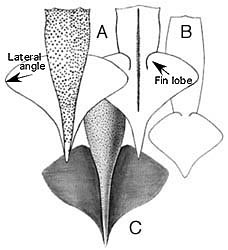
Figure. A - Abralia andamanica, ventral and dorsal views,, modified from Voss, 1963. B - Gonatus fabricii, dorsal view, modified from Naef, 1921. C - Onychoteuthis borealijaponicus, ventral view, modified from Young, 1972.
Rhomboid fins
Rhomboid fins are similar to sagittate fins except that the posterolateral fin margin is not concave but straight.
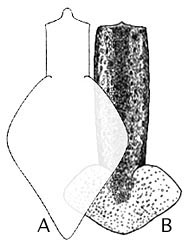
Figure. A - Loligo forbesi modified from Naef, 1921/23. B - Berryteuthis anonychus modified from Pearcy and Voss, 1963.
Circular/elliptical fins
Circular/elliptical fins lack posterior fin-lobes, have or lack anterior fin-lobes and and have broadly rounded or no lateral fin angles. The circular to elliptical outline describes the shape of the combined fins.

Figure. A - Discoteuthis laciniosa modified from Young and Roper, 1969. B - Liocranchia reinhardti modified from Voss, 1963. C - Joubiniteuthis portieri modified from Young and Roper, 1969. D - Chiroteuthis picteti modified from Voss, 1963.
Lanceolate fins
Lanceolate fins are elongate in the anterior-posterior direction, lack posterior fin lobes, usually have reduced anterior fin lobes and lack a lateral angle. The resulting shape is similar to the head of a lance.

Figure. Galiteuthis glacialis modified from McSweeny, 1978.
Ear-shaped fins
Ear-shaped fins have both anterior and posterior fin lobes and lack lateral angles. The fins often are completely separate from one another.
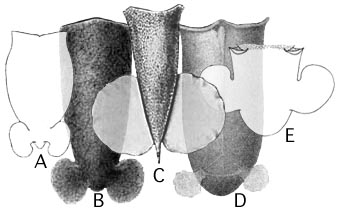
Figure. A - Idiosepius pygmaeus, modified from Voss, 1963. B - Bathyteuthis abyssicola modified from Roper, 1969. C - Pyroteuthis addolux modified from Young, 1972. D - Bathothauma lyromma modified from Chun, 1910. E - Iridoteuthis iris, modified from Naef, 1921-23.
Lobate fins
Lobate fins have a posterior fin-lobe and lack an anterior one. No lateral angle exists and each fin is often much longer than broad.
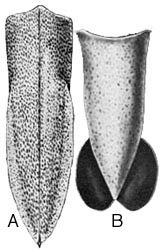
Figure. A - Dorsal view of Neoteuthis sp., modified from Young, 1972. B - Ventral view of Alluroteuthis antarcticus, modified from Roper, et al., 1969.
Ribbed fins
Ribbed fins have a series of independent muscle bundles within each fin that look like a series of ribs or teeth on a comb. The fin is long and slender and without lateral angles.
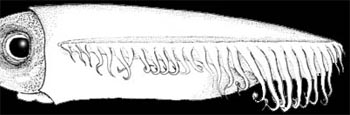
Figure. Side view of Chtenopteryx, modified from Okutani, 1974.
Skirt-like fins
Skirt-like fins are narrow and extend along the lateral margins of the mantle. They have free anterior and posterior lobes and lack lateral angles..

Figure. Dorsal view of Sepia orbigyana, modified from Naef, 1921-23.


