


Planctoteuthis oligobessa
Richard E. Young and Clyde F. E. Roper
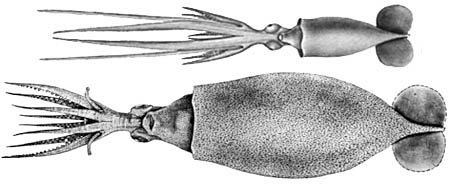
Introduction
Planctoteuthis oligobessa is a small species (maximum size = 76 mm ML). It can be separated from subadults of other members of the genus by the small fins and few suckers on arms IV. Little is known of its biology.
Brief diagnosis:
A Planctoteuthis with ...- 2-4 suckers on each arm IV.
- fin length 1/4 - 1/3 of ML.
Characteristics
- Arms
- 2-4 suckers on each arm IV.
- Arm lengths: Arms I: 32-39% of ML (subadults); arms I: 24-25% of ML (adults); arms III: 47-61% of ML (subadults). arms IV: 121-135% of ML (subadults); arms II-IV 29-39% of ML (adults).
- Large arm suckers with 25-35 small, narrow, blunt teeth on distal 3/4 of ring. Click on an image to view larger version & data in a new window
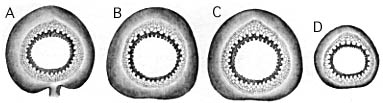
Figure. Oral view of large arm suckers of P. oligobessa, 27 mm ML. A-D - Suckers from arm I-IV respectively.
- Tentacles
- Clubs bilaterally symmetrical in shape.
- Club length 12-18% of ML.
- Suckers without teeth on inner ring.
- Clubs without keels. Click on an image to view larger version & data in a new window
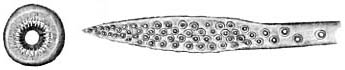
Figure. Oral views of club sucker and club, 27 mm ML. Drawings from Young (1972).
- Head
- Beaks: Descriptions can be found here: Lower beak; upper beak.
- Beaks: Descriptions can be found here: Lower beak; upper beak.
- Funnel
- Locking apparatus with slender antitragus consisting of a single lobe. Click on an image to view larger version & data in a new window

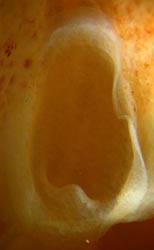
Figure. Funnel locking apparatuses of P. oligobessa. Left - 27 mm ML. Drawing from Young (1972). Right - Subadult, off Southern California.
- Locking apparatus with slender antitragus consisting of a single lobe.
- Fins
- Length 23-33% of ML.
- Measurements
*Without carpusParatype Paratype Holotype Sex -- -- Female Mantle length 34 34 76 Mantle width 11 11 28 Fin length 7 8 14 Fin width 12 -- -- Length, arm I 12 11 19 Length, arm II 15 15 27 Length, arm III 18 16 29 Length, arm IV 46 41 30 Club length* 6 4 -- Arm IV sucker count (left / right) 3 / -- 3 / 2 2 / 3
Comments
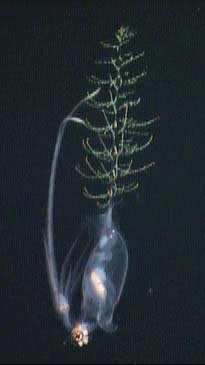
Individuals of Planctoteuthis taken in trawls invariably show a broken gladius at the posterior end of the fin. The existence of a long and decorative tail was not known until ROV photographs captured insitu images. These images were taken by the Monterey Bay Aquarium Research Institute. The ventrally bulging eyes identify it as Planctoteuthis and the locality off California strongly suggests that it is P. oligobessa. The function of the tail is unknown although Vecchione et al. (1992) noted that the tail of Chiroteuthis (see Chiroteuthidae page) causes the young squid to resemble certain siphonophores suggesting protective mimicry.
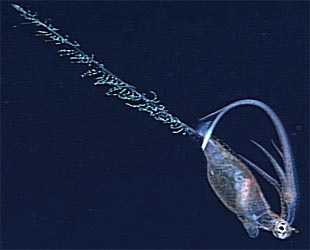
Figures. Lateral views, insitu with natural orientation, apparently of P. oligobessa, taken by a remotely operated vehicle (ROV) off California. Left image © MBARI 2001. Right image © MBARI 2011.
Nomenclature
This species was originally described as Valbyteuthis oligobessa. Valbyteuthis is now placed in the synonomy of Planctoteuthis (Young, 1991).
Life history
Paralarval stages for P. oligobessa are unknown.The holotype is a gravid, mated female with mature ovarian eggs of 1.5 mm in diameter. Spermatangia were found within the ovary. Fertilization, apparently, is internal.
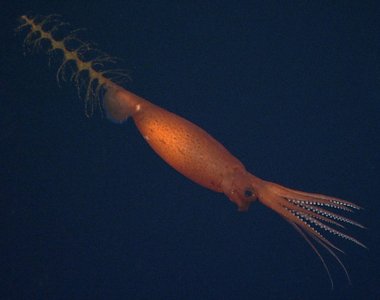
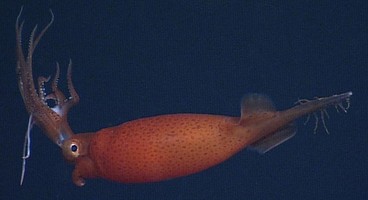
Figure. These two images of, presumably, P. oligobessa are apparently much older than those shown previously judging by the heavy pigmentation. Both images could be of adult squid, especially the bottom one with the damaged tail. Both images: © 2011 MBARI.
Distribution
Vertical distribution
The vertical distribution of P. oligobessa off southern California extends from 700 - 1200m (the maximum depth of the trawling program). The highest capture rate occurred in the 1100-1200 m zone and this species was one of the deepest living cephalopods taken in this program (Roper and Young, 1975). There is no difference between daytime and nighttime distributions.
Geographical distribution
P. oligobessa has been described only from the waters off southern California and northern Baja California; Nesis (1982/87) indicates that the distribution extends to Indonesian waters.
Title Illustrations

| Scientific Name | Planctoteuthis oligobessa, Planctoteuthis oligobessa (2) |
|---|---|
| Location | Pacific Ocean off California |
| Comments | note the long arms IV and the strong ventral protrusion of the eyes from the head (1) |
| Reference | Young, R. E. 1972. The systematics and areal distribution of pelagic cephalopods from the seas off southern California. Smithson. Contr. Zool., No. 97: 159pp |
| Creator | C. McSweeny |
| Specimen Condition | Dead Specimen |
| Sex | f (2) |
| Life Cycle Stage | subadult, mature (2) |
| View | Ventral |
| Size | 23 mm ML, 76 mm ML (2) |
| Type | holotype (2) |
| Image Use |
 This media file is licensed under the Creative Commons Attribution-NonCommercial License - Version 3.0. This media file is licensed under the Creative Commons Attribution-NonCommercial License - Version 3.0.
|
| Copyright |
©

|
About This Page
University of Hawaii, Honolulu, HI, USA
Smithsonian Institution, Washington, D. C., USA
Page copyright © 2014 and
 Page: Tree of Life
Planctoteuthis oligobessa .
Authored by
Richard E. Young and Clyde F. E. Roper.
The TEXT of this page is licensed under the
Creative Commons Attribution-NonCommercial License - Version 3.0. Note that images and other media
featured on this page are each governed by their own license, and they may or may not be available
for reuse. Click on an image or a media link to access the media data window, which provides the
relevant licensing information. For the general terms and conditions of ToL material reuse and
redistribution, please see the Tree of Life Copyright
Policies.
Page: Tree of Life
Planctoteuthis oligobessa .
Authored by
Richard E. Young and Clyde F. E. Roper.
The TEXT of this page is licensed under the
Creative Commons Attribution-NonCommercial License - Version 3.0. Note that images and other media
featured on this page are each governed by their own license, and they may or may not be available
for reuse. Click on an image or a media link to access the media data window, which provides the
relevant licensing information. For the general terms and conditions of ToL material reuse and
redistribution, please see the Tree of Life Copyright
Policies.
- Content changed 21 January 2014
Citing this page:
Young, Richard E. and Clyde F. E. Roper. 2014. Planctoteuthis oligobessa . Version 21 January 2014 (under construction). http://tolweb.org/Planctoteuthis_oligobessa/19496/2014.01.21 in The Tree of Life Web Project, http://tolweb.org/


