


Pterygioteuthis
Annie Lindgren, Richard E. Young, and Katharina M. Mangold (1922-2003)
Introduction
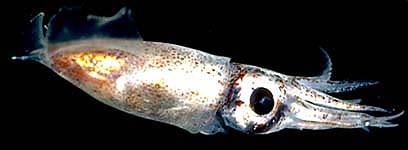
Species of Pterygioteuthis are probably the smallest of all oceanic squids (Oegopsida). P. microlampas, for example, has a maximum size of 23 mm ML and short arms. One of the most distinctive features of the genus is the presence of a photophore on each eye that has a lid that can open and close over the organ. This photophore can produce a brilliant flash. The lid, presumably, allows a sudden beginning and end to the flash and, when closed, conceals the reflector that lies behind the photogenic tissue. Concealment is important as the reflector otherwise could reveal the squids presence in dark waters to predators that use luminescent search lights. A second pair of flashing photophores that lacks lids is located at the base of the gills. These latter organs are much larger than their counterparts in Pyroteuthis; the size difference is present in paralarvae and is helpful in distinguishing paralarvae of the two genera (Young, et al., 1992).
Members of the genus also have a distinctive hectocotylized arm that contains a peculiar toothed plate and large swollen regions containing folded, glandular tubes of unknown function (Chun, 1910).
Brief diagnosis:
A pyroteuthid ...
- with suckers but without hooks on tentacular club.
- with less than eight hooks on each arm.
Characteristics
- Arms
- Arm hooks in one or two series depending on species.
- Less than 8 hooks/arm.
- Female arms IV generally lack hooks with a maximum two hooks present on right arm IV in male P. giardi and P. hoylei.
- Left arm IV hectocotylized; toothed plate present.
- Tentacles
- Tentacular club with four series of suckers; hooks absent.
- Tentacular club with four series of suckers; hooks absent.
- Photophores
- Eyeball with a lidded photophore.
- Two or four separate photophores in tentacular stalk.
- Visceral photophores
- One anterior abdominal photophore.
- Branchial photophores larger than anal photophores .
- Oviducts
- Only right oviduct present.
Comments
Of the four species of Pterygioteuthis, 2 species groups are present based on similar morphological characters: P. giardi group (containing P. giardi and P. hoylei) and a P. gemmata group (containing P. gemmata and P. microlampas).
Comparison table for the species groups (from Lindgren, 2010).
| Hooks on arms I-III* | Distal suckers on arms II-III | Arm I distal suckers* | Hectocotylus plate | Female arm IV | Small eye photohores* | Tentacular club suckers: Dorsal series* | Buccal membrane* | |
| P. giardi group | 2 series | Absent | Globular | 2 large teeth | suckers absent | 5 | Not enlarged | Ridges |
| P. gemmata group | 1 ventral series | Present | Normal | Many small teeth | suckers present (2 series) | 4 | Enlarged | Papillae |
* See below for further explanation of characters.
- Arms - hooks can be in 1 or 2 series.
Click on an image to view larger version & data in a new window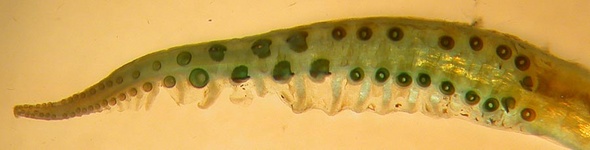
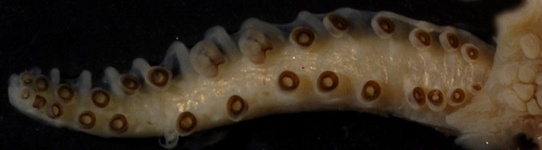
Figure. Top - P. giardi - left arm I (ventral side up) with distal globular suckers. Bottom - P. gemmata- right arm I (ventral side down) with regular distal suckers. ©
- Arms II and III - arm tips with or without suckers.
Click on an image to view larger version & data in a new window
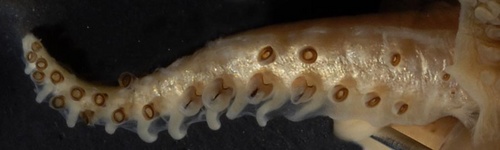
Figure. Oral views from arms II. Top - P. hoylei, right arm with 1 mintue distal sucker. Bottom - P. gemmata, left arm with distal suckers (1 distal sucker and 2 proximal suckers missing). ©
- Tentacle clubs - can be in 4 even or uneven series.
Click on an image to view larger version & data in a new window
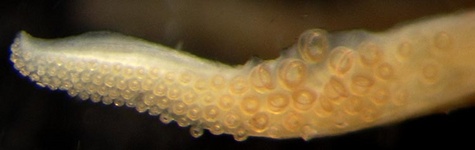
Figure. Tentacular clubs. Top - P. hoylei. Bottom - P. microlampas. ©
- Buccal membrane - can have ridges or papilla.
Click on an image to view larger version & data in a new window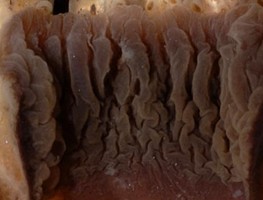
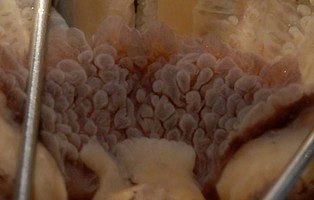
Figure. Buccal membranes. Top/Left - P. hoylei. Bottom/Right - P. microlampas. ©
- Small eye photophores - can have 4 or 5.
Click on an image to view larger version & data in a new window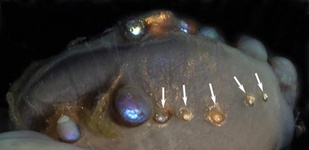
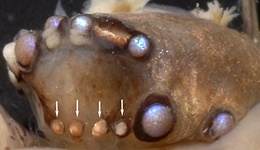
Figure. Small eye photophores. Top/Left - 5 small organs from P. giardi. Bottom/Right - 4 small organs from P. microlampas. ©
Discussion of Phylogenetic Relationships
The first in-depth cladistic analysis of Pterygioteuthis was based on 24 morphological characters (Lindgren, 2010) yielded two distinct clades: a P. gemmata group and a P. giardi group. Monophyly for Pterygioteuthis and Pyroteuthis as well as the family received high degrees of support.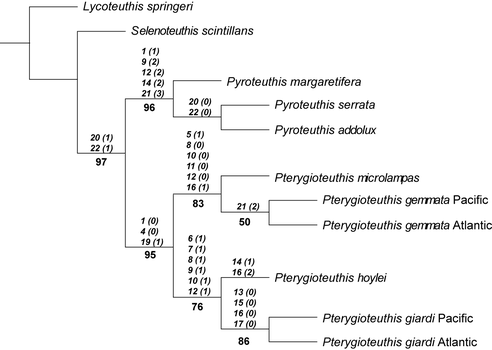
Figure. A phylogenetic topology of Pterygioteuthis based on 24 morphological character (Lindgren, 2010). Numbers in italics above nodes represent characters found in a specific clade (see Lindgren, 2010 for a description of characters and states). Numbers in bold below nodes represent jackknife suport values.
Behavior
P. microlampas and P. giardi have been observed to produce a variety of different bioluminescent flashes with their lidded-ocular and branchial photophores. The latter photophores can be rotated to point the flash in different directions. These two pairs of photophores can flash for varying durations and in various combinations suggesting that flashing behavior which, presumably, deters predators is complex (Young, et al., 1982). P. giardi has also been shown to counterilluminate in the laboratory (Young, et al., 1980).
Distribution
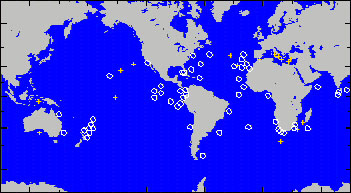
Species of Pterygioteuthis are found throughout the tropical and temperate regions of the world's oceans but are virtually absent from the Mediterranean Sea. This map shows the general localities (white circles) where species belonging to this genus have been captured. Localities where pyroteuthids, other than Pterygioteuthis, have been captured are indicated by orange crosses. Only one record per locality is included (records listed here).
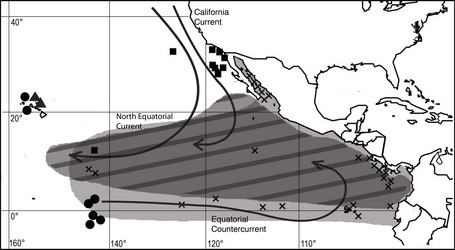
Members of Pterygioteuthis have a very interesting distribution pattern in the eastern Tropical Pacific.
References
Chun, C. 1910. Die Cephalopoden. Oegopsida. Wissenschaftliche Ergebnisse der Deutschen Tiefsee-Expedition, "Valdivia" 1898-1899, 18: 1-522 + Atlas.
Lindgren, A.R. 2010. Systematics and distribution of the squid genus Pterygioteuthis (Cephalopoda:Oegopsida) in the eastern tropical Pacific Ocean. Journal of Molluscan Studies, 76(4): 389-398.
Riddell, D. J. 1985. Enoploteuthidae of the New Zealand Region. Fisheries Research Bulletin. New Zealand Ministry of Agriculture and Fisheries, 27: 1-52.
Young, R. E. 1972. The Systematics and Areal Distribution of Pelagic Cephalopods from the Seas off Southern California. Smithson. Contr. Zool., 97: 1-159.
Young, R. E., E. M. Kampa, S. D. Maynard, F. M. Mencher and C. F. E. Roper (1980) counterillumination and the upper depth limits of midwater animals. Deep-Sea Res., 27A: 671-691.
Young, R. E., K. M. Mangold and M. Vecchione. 1992. The enoploteuthid group of families. P. 55-66. In: Sweeney, M. J., C. F. E. Roper, K. M. Mangold, M. R. Clarke and S. V. Boletzky (eds.). "Larval" and juvenile cephalopods: a manual for their identification. Smithson. Contr. Zool., No. 513: 1-282.
Young, R. E., R. R. Seapy, K. M. Mangold and F. G. Hochberg. 1982. Luminescent Flashing in the Midwater Squids Pterygioteuthis microlampas and P. giardi. Mar. Biol., 69: 299-308.
Title Illustrations

| Scientific Name | Pterygioteuthis microlampas |
|---|---|
| Location | Hawaiian waters |
| Image Use |
 This media file is licensed under the Creative Commons Attribution-NonCommercial License - Version 3.0. This media file is licensed under the Creative Commons Attribution-NonCommercial License - Version 3.0.
|
| Copyright |
© 1996

|
About This Page
Ohio State University, Columbus, Ohio, USA
University of Hawaii, Honolulu, HI, USA
Katharina M. Mangold (1922-2003)
Laboratoire Arago, Banyuls-Sur-Mer, France
Correspondence regarding this page should be directed to Annie Lindgren at
Page copyright © 2019 and
All Rights Reserved.
- Content changed 11 January 2011
Citing this page:
Lindgren, Annie, Richard E. Young, and Katharina M. Mangold (1922-2003). 2011. Pterygioteuthis . Version 11 January 2011 (under construction). /Pterygioteuthis/19747/2011.01.11 in The Tree of Life Web Project, /


