


Apiochaeta
Owen Lonsdale and Steve Marshall

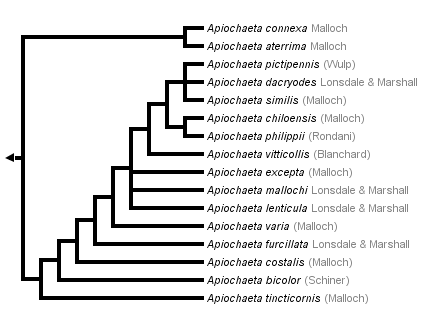


This tree diagram shows the relationships between several groups of organisms.
The root of the current tree connects the organisms featured in this tree to their containing group and the rest of the Tree of Life. The basal branching point in the tree represents the ancestor of the other groups in the tree. This ancestor diversified over time into several descendent subgroups, which are represented as internal nodes and terminal taxa to the right.

You can click on the root to travel down the Tree of Life all the way to the root of all Life, and you can click on the names of descendent subgroups to travel up the Tree of Life all the way to individual species.
For more information on ToL tree formatting, please see Interpreting the Tree or Classification. To learn more about phylogenetic trees, please visit our Phylogenetic Biology pages.
close boxIntroduction
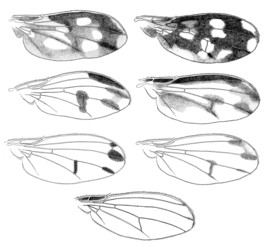
Apiochaeta Czerny wings: A. philippi (Rondani); A. pictipennis (Wulp); A. chiloensis (Malloch); A. vitticollis (Blanchard); A. excepta (Malloch); A. varia (Malloch); A. costalis (Malloch)
The 16 species of this genus were revised by Lonsdale & Marshall (2008), who redefined the genus to include all of those species previously treated as Alloclusia Hendel, which is now considered to be a junior synonym of the senior Apiochaeta. The Chilean fauna was previously treated by Malloch in 1933, who described most of the species in the genus.
Characteristics
Apiochaeta is a distinct, large-bodied genus of flies that can be readily diagnosed by three dorsocentral bristles, an angulate cell dm, an elongate curved distiphallus with one pair of lateral spinulose projections, and a ventral receptacle with numerous transverse wrinkles and two ventral longitudinal furrows (Lonsdale & Marshall, 2008). One pair of sister-species including Apiochaeta aequalis Malloch is characterized by a broad head, inset posterior fronto-orbital bristles and usually white notal patches; most other species like Apiochaeta pictipennis (Wulp) are large, pale, strongly striped, and often with elaborately patterned wings.
Similar to species of Clusiinae, Apiochaeta (which belongs to the subfamily Sobarocephalinae (Lonsdale et al. (2010)) also has a small ratio of the length of the ultimate section of vein M to the penultimate, a subnotal stripe, outstanding bristles on the posterodorsal surface of the fore femur, a bent or jointed distiphallus (although is it not broken medially), and a posteromedial truncated notch on the vertex (Lonsdale & Marshall, 2006). It differs most obviously from these genera in having a preapical bristle on the mid tibia, three dorsocentral bristles, a large surstylus and a south temperate New World distribution.
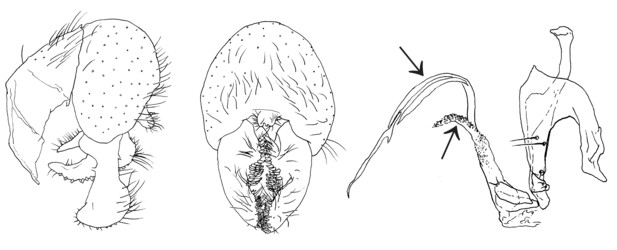
Figure: Apiochaeta pictipennis (Wulp) male genitalia; hypandrial complex not to scale. © Owen Lonsdale.
Phylogenetics
Lonsdale & Marshall (2008) compared Apiochaeta to Clusia as follows, noting the similarities that originally supported its placement in the Clusiinae (see Lonsdale & Marshall (2006)):Apiochaeta, like the Holarctic and Oriental Clusia Haliday, 1839, has an inclinate anterior fronto-orbital bristle, a presutural intra-alar bristle, an M1,2 ratio less than 2.5 (3.0 in A. bicolor (Schiner)), a fore femur with several outstanding posterodorsal bristles, three rows of ventral ctenidial bristles on the male fore and mid femora (one anterior, two posterior), a subnotal stripe, an elongate and medially bent distiphallus and a truncate notch on the posterior margin of the frons behind the ocelli.
Despite these strong morphological similarities, however, the combined morphological and molecular evidence presented in Lonsdale et al. (2010) supports this genus as basal in the Sobarocephalinae, illustrating an unusual example of morphological homoplasy. This makes additional sense biogeographically, as the redefined Sobarocephalinae now contains all endemic New World genera, and is divided between the south and north with the south temperate lineage of Apiochaeta and the tropical lineage of Sobarocephala, Chaetoclusia and Procerosoma.
References
Czerny, P.L. 1903. Revision der Heteroneuriden. Wiener Entomologische Zeitung 22(3): 61-108.
Lonsdale, O. & Marshall, S.A. 2006. Redefinition of the Clusiinae and Clusiodinae, description of the new subfamily Sobarocephalinae, revision of the genus Chaetoclusia and a description of Procerosoma gen. n. (Diptera: Clusiidae). European Journal of Entomology, 103: 163-182.
Lonsdale, O. & Marshall, S.A. 2008. Revision of the temperate South American genus Apiochaeta Czerny, 1903, with synonymy of Alloclusia Hendel, 1917 (Diptera: Clusiidae). Zootaxa 1944: 1-33.
Lonsdale, O., Marshall, S.A., Fu, J. & Wiegmann, B. 2010. Phylogenetic analysis of the druid flies (Diptera: Schizophora: Clusiidae) based on morphological and molecular data. Insect Systematics & Evolution 41: 231-274.
Malloch, J.R. 1933. Facile 4 – Acalyptrata [part]. The Diptera of Patagonia and South Chile. Clusiidae. Pt. VI pp. 232-245. British Museum of Natural History, London, 499pp.
Melander, A.L. & N.G. Argo. 1924. Revision of the two-winged flies of the family Clusiidae. Proceedings of the United States Natural History Museum 64: 1-54.
Title Illustrations

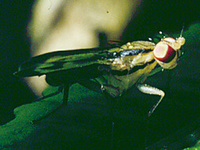
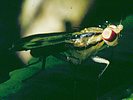
| Scientific Name | Apiochaeta similis-complex |
|---|---|
| Specimen Condition | Live Specimen |
| Sex | Female |
| Copyright |
© Steve Marshall

|
| Location | Chile |
|---|---|
| Specimen Condition | Live Specimen |
| Life Cycle Stage | Adult |
| Copyright |
© 2004 Steve Marshall
|
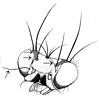
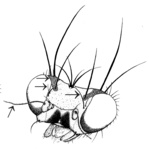
| Scientific Name | Apiochaeta connexa Malloch |
|---|---|
| Specimen Condition | Dead Specimen |
| Life Cycle Stage | Adult |
| Body Part | Head |
| Image Use |
 This media file is licensed under the Creative Commons Attribution-NonCommercial License - Version 3.0. This media file is licensed under the Creative Commons Attribution-NonCommercial License - Version 3.0.
|
| Copyright |
© Owen Lonsdale
|

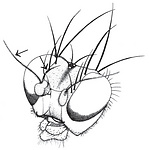
| Scientific Name | Apiochaeta vitticollis (Blanchard) |
|---|---|
| Location | Chile |
| Specimen Condition | Dead Specimen |
| Life Cycle Stage | Adult |
| Body Part | Head |
| Image Use |
This media file is licensed under the Creative Commons Attribution-NonCommercial License - Version 3.0.
|
| Copyright |
© Owen Lonsdale
|
About This Page
Owen Lonsdale
Canadian National Collection of Insects, Arachnids & Nematodes
Steve Marshall
University of Guelph, Canada
Correspondence regarding this page should be directed to Owen Lonsdale at and Steve Marshall at
Page copyright © 2011 Owen Lonsdale and Steve Marshall
 Page: Tree of Life
Apiochaeta.
Authored by
Owen Lonsdale and Steve Marshall.
The TEXT of this page is licensed under the
Creative Commons Attribution-NonCommercial License - Version 3.0. Note that images and other media
featured on this page are each governed by their own license, and they may or may not be available
for reuse. Click on an image or a media link to access the media data window, which provides the
relevant licensing information. For the general terms and conditions of ToL material reuse and
redistribution, please see the Tree of Life Copyright
Policies.
Page: Tree of Life
Apiochaeta.
Authored by
Owen Lonsdale and Steve Marshall.
The TEXT of this page is licensed under the
Creative Commons Attribution-NonCommercial License - Version 3.0. Note that images and other media
featured on this page are each governed by their own license, and they may or may not be available
for reuse. Click on an image or a media link to access the media data window, which provides the
relevant licensing information. For the general terms and conditions of ToL material reuse and
redistribution, please see the Tree of Life Copyright
Policies.
- First online 25 August 2005
- Content changed 06 January 2011
Citing this page:
Lonsdale, Owen and Steve Marshall. 2011. Apiochaeta. Version 06 January 2011 (under construction). http://tolweb.org/Apiochaeta/27673/2011.01.06 in The Tree of Life Web Project, http://tolweb.org/

