


Neoaves
David P. Mindell, Joseph W. Brown, and John Harshman
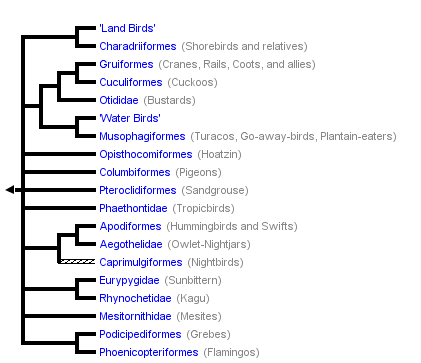


This tree diagram shows the relationships between several groups of organisms.
The root of the current tree connects the organisms featured in this tree to their containing group and the rest of the Tree of Life. The basal branching point in the tree represents the ancestor of the other groups in the tree. This ancestor diversified over time into several descendent subgroups, which are represented as internal nodes and terminal taxa to the right.
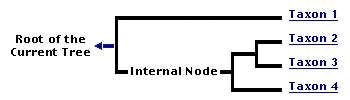
You can click on the root to travel down the Tree of Life all the way to the root of all Life, and you can click on the names of descendent subgroups to travel up the Tree of Life all the way to individual species.
For more information on ToL tree formatting, please see Interpreting the Tree or Classification. To learn more about phylogenetic trees, please visit our Phylogenetic Biology pages.
close boxDiscussion of Phylogenetic Relationships
This tree represents a considerable reorganization of avian relationships on the basis of two extensive genetic studies (Hackett et al. 2008, Ericson et al. 2006). Several traditional orders have been rearranged, and relationships among orders have been greatly altered. Orders may not have their traditional contents. Families and genera listed independently here have been removed from their traditional orders.
Some recent studies of morphology (e.g. Livezey and Zusi 2007) have strongly contradicted this arrangement and have supported traditional relationships.
"Land Birds" and "Water Birds" are informal names for two large clades within Neoaves, each encompassing several traditional orders.
Gruiformes, previously a very diverse order, has been considerably reduced: Eurypygidae (sunbittern), Rhynochetidae (kagu), Otididae (bustards), and Mesitornithidae (mesites) are traditionally considered gruiforms but do not belong there, nor do Cariamidae (seriemas), which are placed within "Land Birds", or Turnicidae (buttonquails), which are placed within Charadriiformes. Phaethontidae (tropicbirds) likewise are traditionally considered to belong to Pelecaniformes, within "Water Birds", but do not belong there.
Caprimulgiformes traditionally includes Aegothelidae (owlet-nightjars), but this familly is more closely related to Apodiformes. Relationships among the remaining families of Caprimulgiformes are currently not well resolved, and we don't yet know whether Caprimulgiformes (with owlet-nightjars removed) is monophyletic or paraphyletic.
Fain and Houde (2004) have suggested that Neoaves is divided into two clades, Coronaves (taxa from "Land Birds" through Musophagiformes on this tree) and Metaves (Opisthocomiformes through Phoenicopteriformes). However, support for this hypothesis is so far restricted to a single gene, and confirmation is needed.
The relationship between Podicipediformes (grebes) and Phoenicopteriformes (flamingos), odd as it seems, was first hypothesized by van Tuinen et al. (2001), and has been confirmed by nearly every subsequent molecular analysis.
References
Braun, E. L. and R. T. Kimball. 2002. Examining basal avian divergences with mitochondrial sequences: model complexity, taxon sampling, and seqeunce length. Syst. Biol. 51:614-625.
Brown, J. W., R. B. Payne, and D. P. Mindell. 2007. Nuclear DNA does not reconcile ‘rocks’ and ‘clocks’ in Neoaves: a comment on Ericson et al. Biol. Lett. 3:257-259.
Christidis, L. and W. Boles. 2008. Systematics and Taxonomy of Australian Birds. CSIRO Publishing, Collingwood, Australia.
Cooper, A. and D. Penny. 1997. Mass survival of birds across the Cretaceous-Tertiary boundary: Molecular evidence. Science 275:1109-1113.
Cracraft, J. 1981. Toward a phylogenetic classification of birds of the world (class Aves). Auk 98: 681-714.
Cracraft, J. 1988. The major clades of birds. In The Phylogeny and Classification of the Tetrapods. (M. J. Benton, ed.), Systematics Assoc. Special Vol. No. 35A, pp. 333-355. Clarendon Press, Oxford.
Cracraft, J. 2001. Avian evolution, Gondwana biogeography and the Cretaceous-Tertiary mass extinction event. Proc. Roy. Soc. Lond. 268B:459-469.
Cracraft, J. and J. Clarke. 2001. The basal clades of modern birds. Pp. 143-156 in New perspectives on the origin and early evolution of birds (J. Gauthier and L. F. Gall, eds.). Peabody Museum of Natural History, Yale University, New Haven, CT.
Cracraft, J., F. K. Barker, M. J. Braun, J. Harshman, G. Dyke, J. Feinstein, S. Stanley, A. Cibois, P. Schikler, P. Beresford, J. García-Moreno, M. D. Sorenson, T. Yuri, and D. P. Mindell. 2004. Phylogenetic Relationships Among Modern Birds (Neornithes): Toward an Avian Tree of Life. Pp 468-489 in Cracraft, J. and M. J. Donoghue (eds.), Assembling the Tree of Life. Oxford University Press, New York.
Cracraft, J., and D. P. Mindell. 1989. The early history of modern birds: a comparison of molecular and morphological evidence. In The Hierarchy of Life. (B. Fernholm, K. Bremer and H. Jörnvall, eds.), Proc. of Nobel Symposia, pp. 389-403. Elsevier Science Publishers, Amsterdam.
Dyke GJ, Van Tuinen M. 2004. The evolutionary radiation of modern birds (Neornithes): reconciling molecules, morphology and the fossil record. Zool. J. Linn. Soc. 141: 153-177.
Edwards, S. V., W. B. Jennings and A. M. Shedlock. 2005. Phylogenetics of modern birds in the era of genomics. Proc. R. Soc. B 272:979–992.
Ericson, P. G. P., C. L. Anderson, T. Britton, A. Elzanowski, U. S. Johansson, M. Kallersjo, J. I. Ohlson, T. J. Parsons, D. Zuccon, G. Mayr. 2006. Diversification of Neoaves: integration of molecular sequence data and fossils. Biology Letters 2(4):543-547.
Ericson, P. G. P., L. Christidis, A. Cooper, M. Irestedt, J. Jackson, U. S. Johansson, and J. A. Norman. 2002. A Gondwanan origin of passerine birds supported by DNA sequences of the endemic New Zealand wrens. Proc. Roy. Soc. Lond. 269B:235-241.
Fain, M. G. and P. Houde. 2004. Parallel radiations in the primary clades of birds. Evolution 58:2558-2573.
Feduccia, A. 1999. The Origin and Evolution of Birds. 2nd edition. Yale University Press: New Haven.
García-Moreno, J. and D. P. Mindell. 2000. Using homologous genes on opposite sex chromosomes (gametologs) in phylogenetic analysis: a case study with avian CHD. Molecular Biology and Evolution 17:1826-1832.
García-Moreno, J., M. D. Sorenson and D. P. Mindell. 2003. Congruent avian phylogenies inferred from mitochondrial and nuclear DNA sequences. Journal of Molecular Evolution 57:27-37.
Gibb, G. C., O. Kardailsky, R. T. Kimball, E. Braun, and D. Penny. 2007. Mitochondrial genomes and avian phylogeny: complex characters and resolvability without explosive radiations. Molecular Biology and Evolution 24:269-280.
Gill, F. B. 1990. Ornithology. W. H. Freeman and Co., New York.
Gill, F. and M. Wright. 2006. Birds of the World: Recommended English Names. Princeton NJ: Princeton University Press.
Groth, J. G. and G. F. Barrowclough. 1999. Basal divergences in birds and the phylogenetic utility of the nuclear RAG-1 gene. Mol. Phylog. Evol. 12: 115-123.
Hackett, S. J., Kimball, R. T., Reddy, S., Bowie, R. C. K., Braun, E. L., Braun, M. J., Chojnowski, J. L., Cox, W. A., Han, K.-L., Harshman, J., Huddleston, C. J., Marks, B. D., Miglia, K. J., Moore, W. A., Sheldon, F. H., Steadman, D. W., Witt, C. C., and Yuri, T. 2008. A phylogenomic study of birds reveals their evolutionary history. Science 320(5884):1763-1768.
Harrison GL, McLenachan PA, Phillips MJ, Slack KE, Cooper A, Penny D. 2004. Four new avian mitochondrial genomes help get to basic evolutionary questions in the late Cretaceous. Mol.Phylogenet. Evol. 21:974-983.
Hedges, S. B., Simmons, M. D., van Dijk, M. A. M., Caspers, G.-J., de Jong, W. W., and Sibley, C. G. 1995. Phylogenetic relationships of the hoatzin, an enigmatic South American bird. Proc. Natl. Acad. Sci. USA 92: 11662-11665.
Hedges, S. B., Parker, P. H., Sibley, C. G., and Kumar, S. 1996. Continental breakup and the ordinal diversification of birds and mammals. Nature 381: 226-229.
Hennig, W. 1966. Phylogenetic Systematics. Univ. of Illinois Press, Urbana.
Hughes, J. M. and A. J. Baker. 1999. Phylogenetic relationships of the enigmatic hoatzin (Opisthocomus hoazin) resolved using mitochondrial and nuclear gene sequences. Mol. Biol. Evol. 16:1300-1307.
Johansson, U. S., T. J. Parsons, M. Irestedt, and P. G. P. Ericson. 2001. Clades within the "higher land birds", evaluated by nuclear DNA sequences. J. Zool. Syst. Evol. Res. 39:37-51.
Johnson, K. P. 2001. Taxon sampling and the phylogenetic position of Passeriformes: evidence from 916 avian cytochrome b sequences. Syst. Zool. 50:128-136.
Livezey, B. C., and R. L. Zusi. 2007. Higher-order phylogeny of modern birds (Theropoda, Aves: Neornithes) based on comparative anatomy. II. Analysis and discussion. Zool. J. Linn. Soc. 149:1-95.
Mayr, E., and Cottrell, G. W. 1979. Revision of the Work of J. L. Peters: Check-list of Birds of the World, Vol. 1. Mus. of Comp. Zool., Cambridge.
Mayr, G. 2002. Osteological evidence for paraphyly of the avian order Caprimulgiformes (nightjar and allies). J. für Ornithol. 143:82-97.
Mayr G. 2003. The phylogenetic affinities of the Shoebill (Balaeniceps rex). J. für Ornithol. 144: 157-175.
Mayr G. 2004. Morphological evidence for sister group relationship between flamingos (Aves : Phoenicopteridae) and grebes (Podicipedidae). Zool. J. Linn. Soc. 140 (2): 157-169.
Mayr, G. 2005. Tertiary plotopterids (Aves, Plotopteridae) and a novel hypothesis on the phylogenetic relationships of penguins (Spheniscidae). Journal of Zoological Systematics and Evolutionary Research 43(1):61–71.
Mayr, G. 2008. Avian higher-level phylogeny: well-supported clades and what we can learn from a phylogenetic analysis of 2954 morphological characters. Journal of Zoological Systematics and Evolutionary Research 46(1):63–72.
Mayr G, Manegold A, Johansson U. 2003. Monophyletic groups within 'higher land birds' - comparison of morphological and molecular data (vol 41, pg 233, 2003) J. Zool. Syst. Evol. Res. 42:173-174.
Mayr G, Clarke J. 2003. The deep divergences of neornithine birds: a phylogenetic analysis of morphological characters. Cladistics 19:527-553.
Mindell, D. P. (ed.). 1997. Avian Molecular Evolution and Systematics. Academic Press: San Diego.
Mindell, D. P., M. D. Sorenson, D. E. Dimcheff, M. Hasegawa, J. C. Ast, and T. Yuri. 1999. Interordinal relationships of birds and other reptiles based on whole mitochondrial genomes. Syst. Biol. 48: 138-152.
Mindell, D. P., M. D. Sorenson, C. J. Huddleston, H. C. Miranda, Jr., A. Knight, S. J. Sawchuk, and T. Yuri. 1997. Phylogenetic relationships among and within select avian orders based on mitochondrial DNA. Pp. 213-247 in Avian Molecular Evolution and Systematics (D. P. Mindell, ed.). Academic Press: San Diego.
Morgan-Richards, M., S. A Trewick, A. Bartosch-Harlid, O. Kardialsky, M. J. Phillips, P. A. McLenachan and D. Penny. 2008. Bird evolution: testing the metaves clade with six new mitochondrial genomes. BMC Evolutionary Biology 8:20. doi:10.1186/1471-2148-8-20
Olson, S. L. 1985. The fossil record of birds. In Avian Biology (D. S. Farner, J. R. King, and K. C. Parkes, eds.), Vol. 8, pp. 79-238. Academic Press, New York.
Paton, T., O. Haddrath, and A. J. Baker. 2002. Complete mitochondrial DNA genome sequences show that modern birds are not descended from transitional shorebirds. Proc. Roy. Soc. Lond. 269B:839-846.
Peters, J. L. 1931-1951. Check-list of Birds of the World, Vols. 1-7. Mus. of Comp. Zool., Cambridge.
Poe S, Chubb AL. 2004. Birds in a bush: Five genes indicate explosive evolution of avian orders. Evolution 58:404-415.
Pratt, R. C., G. C. Gibb, M. Morgan-Richards, M. J. Phillips, M. D. Hendy, and D. Penny. 2009. Toward resolving deep Neoaves phylogeny: Data, signal enhancement, and priors. Molecular Biology and Evolution 26(2):313-326; doi:10.1093/molbev/msn248
Rasmussen, P. C. and J. C. Anderton. 2005. Birds of South Asia: The Ripley Guide. Lynx Edicions, Barcelona.
Sheldon, F. H. and Bledsoe, A. H. 1993. Avian molecular systematics 1970s to 1990s. Annu. Rev. Ecol. Syst. 24: 243-278.
Sibley, C. G. 1994. On the phylogeny and classification of living birds. J. Avian Biol. 25: 87-92
Sibley, C. G. and Ahlquist, J. E. 1990. Phylogeny and classification of birds: a study in molecular evolution. Yale University Press, New Haven.
Sibley, C. G., and B. L. Monroe, Jr. 1990. Distribution and taxonomy of birds of the world. Yale University Press, New Haven.
Slack, K.E. , F. Delsuc, P.A. McLenachan, U. Arnason and D. Penny. 2007. Resolving the root of the avian mitogenomic tree by breaking up long branches. Mol. Phylogen. Evol. 42:1–13.
Slack, K.E., A. Janke, D. Penny, and U. Arnason. 2003. Two new avian mitochondrial genomes (penguin and goose) and a summary of bird and reptile mitogenomic features. Gene 302:43-52.
Slack, K.E., C. M. Jones, T. Ando, G. L. Harrison, E. Fordyce, U. Arnason, and D. Penny. 2006. Early penguin fossils, plus mitochondrial genomes, calibrate avian evolution. Mol. Biol. Evol. 23:1144-1155.
Sorenson, M. D., E. Oneal, J. García-Moreno, and D. P. Mindell. 2003. More taxa, more characters: the hoatzin problem is still unresolved. Molecular Biology and Evolution 20:1484-1499.
Stanley, S. E. and J. Cracraft. 2002. Higher-level systematic analysis of birds: current problems and possible solutions. Pp. 31-43 in Molecular Systematics and Evolution: Theory and Practice (R. DeSalle, G. Giribet, and W. Wheeler, eds.). Birkhäuser Verlag, Basel.
Stettenheim, P. 1976. Structural adaptations in feathers. Proc. 16th International Ornithol. Congr.: 385-401.
van Tuinen, M., D. B. Butvill, J. A. W. Kirsch, and S. B. Hedges. 2001. Convergence and divergence in the evolution of aquatic birds. Proc. Roy. Soc. Lond. 268B:1-6.
van Tuinen M, Hedges SB. 2004. The effect of external and internal fossil calibrations on the avian evolutionary timescale. J. Paleontol. 78:45-50.
Waddell, P. J., Y. Cao, M. Hasegawa, and D. P. Mindell. 1999. Assessing the Cretaceous superordinal divergence times within birds and placental mammals using whole mitochondrial protein sequences and an extended statistical framework. Systematic Biology 48:119-137.
Watanabe, M., M. Nikaido, T. T. Tsuda, T. Kobayashi, D. Mindell, Y. Cao, N. Okada, and M. Hasegawa. 2006. New candidate species most closely related to penguins. Gene 378:65-73.
Wetmore, A. 1960. A classification for the birds of the world. Smiths. Misc. Coll. 139: 1-37.
Information on the Internet
For bird links, see Neornithes Information on the InternetTitle Illustrations

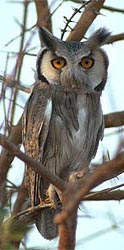
| Scientific Name | Ptilopsis leucotis |
|---|---|
| Location | Botswana (Okavango Delta), Southern Africa |
| Comments | White-faced Owl |
| Specimen Condition | Live Specimen |
| Copyright |
© 1997 Greg and Marybeth Dimijian

|

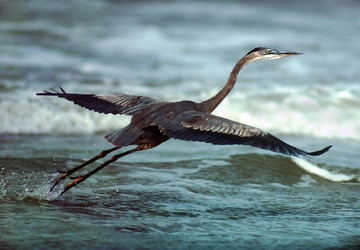
| Scientific Name | Ardea herodias |
|---|---|
| Location | Texas coast |
| Comments | Great Blue Heron |
| Specimen Condition | Live Specimen |
| Behavior | flying |
| Copyright |
© 1997 Greg and Marybeth Dimijian
|
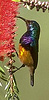
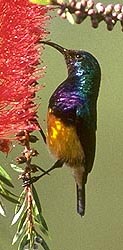
| Scientific Name | Cinnyris venustus |
|---|---|
| Location | Mount Kenya, Kenya, East Africa |
| Comments | Variable Sunbird |
| Specimen Condition | Live Specimen |
| Behavior | feeding |
| Sex | Male |
| Copyright |
© 1997 Greg and Marybeth Dimijian
|
About This Page
David P. Mindell
California Academy of Sciences, San Francisco, California, USA
Joseph W. Brown
University of Michigan Museum of Zoology, Ann Arbor, Michigan, USA
Correspondence regarding this page should be directed to John Harshman at
Page copyright © 2004 David P. Mindell, Joseph W. Brown, and
 Page: Tree of Life
Neoaves.
Authored by
David P. Mindell, Joseph W. Brown, and John Harshman.
The TEXT of this page is licensed under the
Creative Commons Attribution-NonCommercial License - Version 3.0. Note that images and other media
featured on this page are each governed by their own license, and they may or may not be available
for reuse. Click on an image or a media link to access the media data window, which provides the
relevant licensing information. For the general terms and conditions of ToL material reuse and
redistribution, please see the Tree of Life Copyright
Policies.
Page: Tree of Life
Neoaves.
Authored by
David P. Mindell, Joseph W. Brown, and John Harshman.
The TEXT of this page is licensed under the
Creative Commons Attribution-NonCommercial License - Version 3.0. Note that images and other media
featured on this page are each governed by their own license, and they may or may not be available
for reuse. Click on an image or a media link to access the media data window, which provides the
relevant licensing information. For the general terms and conditions of ToL material reuse and
redistribution, please see the Tree of Life Copyright
Policies.
- First online 14 December 2005
- Content changed 27 June 2008
Citing this page:
Mindell, David P., Joseph W. Brown, and John Harshman. 2008. Neoaves. Version 27 June 2008 (under construction). http://tolweb.org/Neoaves/26305/2008.06.27 in The Tree of Life Web Project, http://tolweb.org/

