


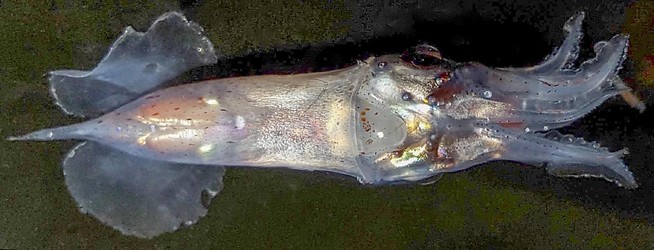
Pterygioteuthis gemmata
Annie Lindgren, Richard E. Young, and Katharina M. Mangold (1922-2003)
Introduction
Brief Diagnosis:
A Pterygioteuthis with...
- arms III with 6-7 hooks in California (3-4 hooks in North Atlantic).Click on an image to view larger version & data in a new window

Figure. Pterygioteuthis gemmata, 23 ML, ventral view. Drawing from Young, 1972.
Pterygioteuthis microlampas and P. gemmata are very similar but are most easily separated by the smaller size of adult P. microlampas and fewer number of hooks on the arms of males of this species (Riddell, 1985).
Characteristics
- Arms - hooks on arms I-III in 1 series (ventral).
- Arms I
- 6-8 pairs of suckers proximal to hooks.
- 2-5 hooks in males and females.
- Small, normal (non-globular) suckers distal to hooks.
Click on an image to view larger version & data in a new window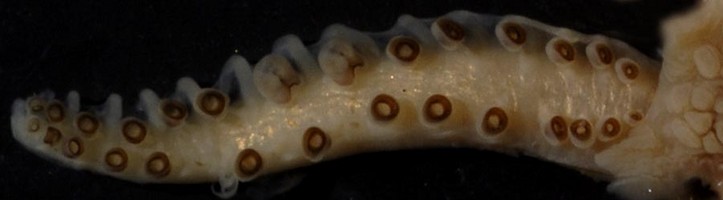
Figure. Oral view of right arm I from a male P. gemmata. ©
- Arms II
- 4-6 pairs suckers proximal to hooks.
- 1-4 hooks in males and females.
- 6-7 pairs small suckers distal to hooks.
Click on an image to view larger version & data in a new window
Figure. Oral view of left arm II from a male P. gemmata (3 suckers are missing - 2 from hook/sucker pair, 1 from distal sucker pair). ©
- Arms III
- 2 pairs suckers proximal to hooks.
- 5-7 hooks in Pacific males and females (3-4 hooks in Atlantic).
- 4-8 pairs small suckers distal to hooks.
Click on an image to view larger version & data in a new window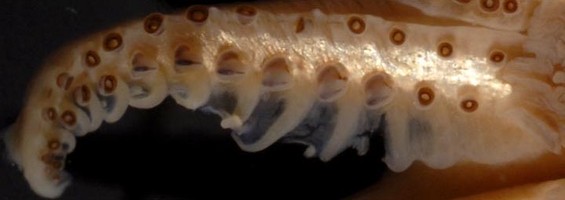
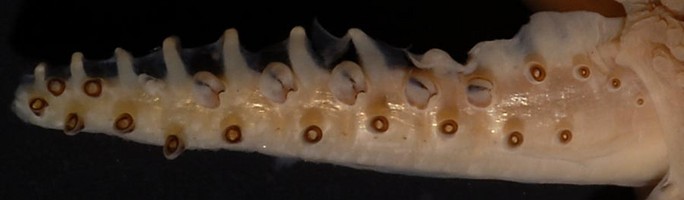
Figure. Oral views of arms III from Pacific P. gemmata. Top - Female, left arm with 6 hooks. Bottom - Male, right arm with 5 hooks and slightly enlarged sheaths. ©
- Arms IV (click here for images)
- 2 series small suckers in males and females.
- Left arm IV hectocotylized; hectocotylus plate with many small teeth.
- 2 series small suckers in males and females.
- Arms I
- Tentacles (click here for images)
- Suckers in 4 series, but proximal 2-4 rows have enlarged dorsal suckers.
- Suckers in 4 series, but proximal 2-4 rows have enlarged dorsal suckers.
- Head (click here for images)
- Buccal crown with papillae (few to no ridges).
- Photophores
- Eye with 10 large and 4 minute photophores. As in P. microlampas.
- Tentacles with 4 embedded photophores (1 large, spherical photophore at bend in base of tentacular stalk; 2 small spherical photophores along stalk, 1 small spherical photophore at club base). As in P. microlampas.
- Eye with 10 large and 4 minute photophores. As in P. microlampas.
- Pigmentation
- Tentacle chromatophores present at base of tentacular stalk, along stalk in a single row, at the base of the tentacle club (clustered over photophore), and cover entire aboral surface of tentacle club (click here for images).
- Funnel chromatophores begin below locking apparatus, extend along funnel side, and occasionally up and across funnel.
Click on an image to view larger version & data in a new window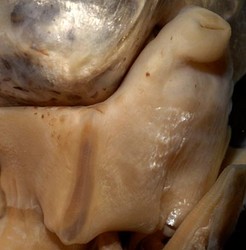
Figure. Ventral view of the funnel and associated chromatophores from a female P. gemmata. ©
- Size
- Females mature at 26 mm ML.
- Maximum length about 32 mm ML.
Comments
Further description of P. gemmata can be found here.
The tentacular club and arm and club suckers are shown here even though species-specific characters have not yet been identified.
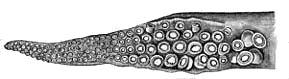
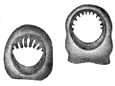
Figure. Oral views of tentacular club and club and arm suckers of P. gemmata. Left - Tentacular club, 28 mm ML. Right - Inner sucker rings of the largest arm III sucker (left) and the largest manus sucker (right), 23 mm ML. Drawings from Young, 1972.
Distribution
Vertical Distribution
Off California, P. gemmata was captured mostly at depths of 300-600 m during the day and in the upper 200 m of depth at night (Roper and Young, 1975). Due to the use of open nets and crude depth recorders, these data lack precision.
Geographical Distribution
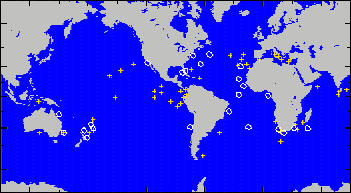
This species was first described from the South Atlantic (Chun, 1908). It has a broad distribution throughout much of the tropical and temperate regions of the Atlantic Ocean. In the Pacific, it seems to be found in temperate waters only: It is known from waters off Southern California (Young, 1972) and south of about 28° S. (to at least 40° S.) in the waters off New Zealand (Riddell, 1982). At this latter location it barely overlaps with its northern congener, P. microlampas (see distribution of this latter species). The following map shows the general localities (white circles) where P. gemmata has been captured. Localities where pyroteuthids other than this species have been captured are indicated by yellow crosses (records listed here).
Geographical variation
P. gemmata individuals from off California have a mean of 21.1 hooks on the lateral arms (all four arms II and III) while squids from the North Atlantic and New Zealand waters have 15.2 and 15.3 (respectively). Specimens from an unidentified region in the South Pacific, however, have 17.3 hooks (Young, 1972). Squids from New Zealand waters have a hectocotylus plate with usually 10 rather even-sized teeth and those from Californian waters usually have 9 teeth of irregular size (see Figure for character no. 1 above).
At present these population differences simply imply that geographical variation exists.
References
Chun, C. 1910. Die Cephalopoden. Oegopsida. Wissenschaftliche Ergebnisse der Deutschen Tiefsee-Expedition, "Valdivia" 1898-1899, 18: 1-522 + Atlas.
Lindgren, A.R. 2010. Systematics and distribution of the squid genus Pterygioteuthis (Cephalopoda: Oegopsida) in the eastern tropical Pacific Ocean. Journal of Molluscan Studies, 76(4): 398-398.
Nesis, K. N. 1982. Abridged key to the cephalopod mollusks of the world's ocean. 385+ii pp. Light and Food Industry Publishing House, Moscow. (In Russian.). Translated into English by B. S. Levitov, ed. by L. A. Burgess (1987), Cephalopods of the world. T. F. H. Publications, Neptune City, NJ, 351pp.
Okutani, T. 1974. Epipelagic decapod cephalopods collected by micronekton tows duringthe EASTROPAC expeditions, 1967-1968 (systematic part). Bull. Tokai Reg. Fish. Res. Lab., 80: 29-118.
Riddell, D. J. 1985. Enoploteuthidae of the New Zealand Region. Fisheries Research Bulletin. New Zealand Ministry of Agriculture and Fisheries, No.27: 1-52.
Roper, C. F. E. and R. E. Young. 1975. Vertical distribution of pelagic cephalopods. Smithsonian Contributions to Zoolog, 209: 1-51.
Young, R. E. 1972. The systematics and areal distribution of pelagic cephalopods from the seas off Southern California. Smithson. Contr. Zool., 97: 1-159.
Title Illustrations

| Scientific Name | Pterygioteuthis gemmata |
|---|---|
| Location | Western North Atlantic |
| Specimen Condition | Fresh |
| Identified By | Michael Vecchione |
| View | Ventral |
| Image Use |
 This media file is licensed under the Creative Commons Attribution-NonCommercial License - Version 3.0. This media file is licensed under the Creative Commons Attribution-NonCommercial License - Version 3.0.
|
| Copyright |
©

|
About This Page
Ohio State University, Columbus, Ohio, USA
University of Hawaii, Honolulu, HI, USA
Katharina M. Mangold (1922-2003)
Laboratoire Arago, Banyuls-Sur-Mer, France
Correspondence regarding this page should be directed to Annie Lindgren at and Richard E. Young at
Page copyright © 2018 , , and Katharina M. Mangold (1922-2003)
All Rights Reserved.
- Content changed 29 March 2018
Citing this page:
Lindgren, Annie, Richard E. Young, and Katharina M. Mangold (1922-2003). 2018. Pterygioteuthis gemmata . Version 29 March 2018 (under construction). /Pterygioteuthis_gemmata/19750/2018.03.29 in The Tree of Life Web Project, /


