A recently hatched Vampyroteuthis (8 mm ML) looks very different in shape, color and general proportions from the paralarva or subadult. The latter two look quite similar except for the different fins present and the smaller size of the eyes in paralarvae. The hatchling, however, differs in having short arms, no web, no dark pigment, no superficial gelatinous layer covering the head and mantle, no fusion of the head and mantle and a narrower gladius in the anterior half. A large amount of yolk can be seen internally through the transparent gladius. The filaments have a uniform diameter throughout, are short and thick, and arise in series with the eight normal arms.

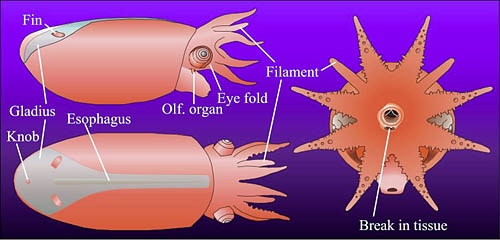
Figure. V. infernalis hatchling, 8 mm ML, captured off Hawaii, 1050-1300 m depth. Drawing modified from Young. and Vecchione, 1999.
The following photograph was made with transmitted light on the newly captured (i.e., unfixed) hatchling. The dark line is a pin placed on the hatchling to keep it from rolling, or floating while being photographed.
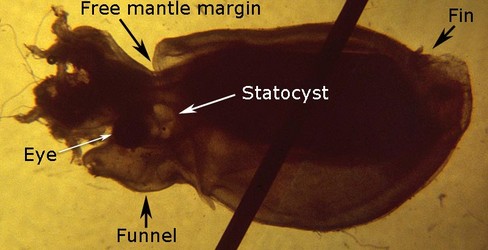
Figure. Lateral view with slight dorsal tilt of V. infernalis, hatchling. Photograph with transmitted light modified from Young. and Vecchione, 1999.
This next photograph was made with reflected light on the preserved and stained (methylene blue) hatchling. The esophagus expands slightly forming a crop.
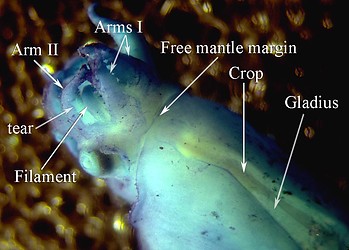
Figure. Reflected light photograph of the V. infernalis hatchling. Photograph modified from Young and Vecchione, 1999.
Either this specimen hatched prematurely due to the trauma of its capture in a trawl, or it indicates that the hatchlings drift in deep water until the yolk is utilized and they then transform into the typical Vampyroteuthis form. The size of the hatchling suggests that it came from an egg of nearly 8 mm in diameter. Pickford (1949) identified 4 mm eggs from plankton tows as belonging to Vampyroteuthis. This discrepancy cannot be explained at present.


