


Pterygioteuthis giardi
Annie Lindgren, Richard E. Young, and Katharina M. Mangold (1922-2003)
Introduction
P. giardi is a very distinctive species. It is easily recognized by the presence of hooks in both armature series on arms I-III, the distinctive hectocotylus and the lack of suckers on the ventral arms in females. These squids are more silvered than the other species in the genus and have extremely small tentacular clubs. In addition, adult females have relatively longer mantles and smaller head and arms.
Brief Diagnosis:
A Pterygioteuthis with ...
- hooks in 2 series on arms I-III.
- arms III with 2-4 hooks.
- 2 tentacular photophores.
Characteristics
- Arms - hooks on arms I-III in 2 series.
- Arms I
- 6-7 pairs of suckers proximal to hooks.
- Arm hooks in 2 sizes: 1-2 pairs large hooks proximal to 3-5 pairs small hooks.
- Small globular suckers distal to hooks.
Click on an image to view larger version & data in a new windowClick on an image to view larger version & data in a new window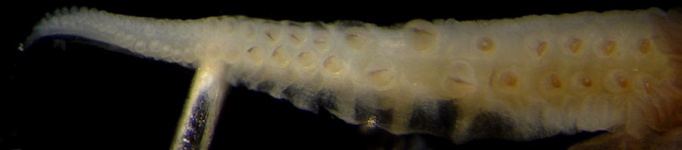
Figure. Oral view of arm I from a female P. giardi. Note 4 large and 8 small hooks. ©
- Arms II
- Suckers proximal to hooks: 4 pair in males, 6-7 pair in females.
- 1-3 pairs of hooks.
- 0-2 small suckers distal to hooks (generally none).
Click on an image to view larger version & data in a new window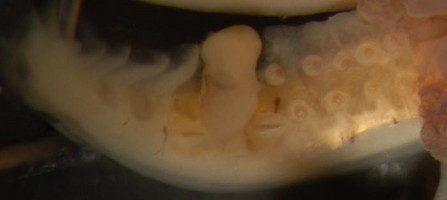
Figure. Oral view of an arm II from a male P. giardi. Note the second enlarged hook with an enlarged sheath. Suckers absent from arm tip. ©
- Arms III
- Suckers proximal to hooks: 2-3 pair in males, 3-5 pairs in females.
- 2-4 hooks (not pairs).
- 0-1 small sucker distal to hooks (generally none).
Click on an image to view larger version & data in a new window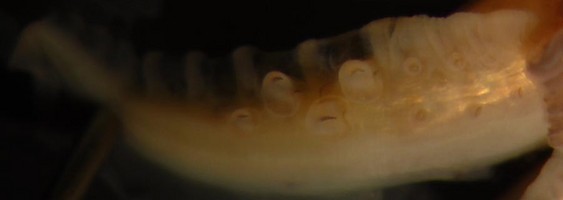
Figure. Ventral view of an arm III from a male P. giardi (4 hooks and 6 suckers visible). ©
- Arms IV (click here for images).
- Female arms without suckers or hooks.
- Male right arm IV with 2 hooks or 1 sucker and 1 hook.
- Male left arm IV hectocotylized; hectocotylus plate with 2 large teeth.
- Arms I
- Tentacles
- Suckers in 4 even series (click here for image).
- Head
- Buccal crown with ridges (no papillae) as in P. hoylei.
- Photophores
- Eye with 10 large and 5 minute photophores (click here for image).
- Tentacles with two embedded photophores (1 large, spherical photophore at bend in base of tentacular stalk; 1 small spherical photophore near midpoint of tentacle).
Click on an image to view larger version & data in a new window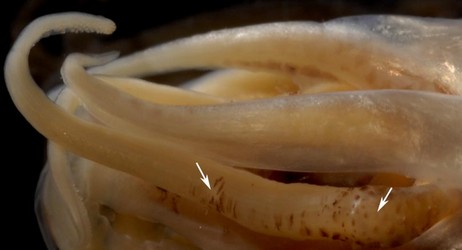
Figure. Ventrolateral view of the right tentacle for P. giardi, showing position of tentacular photophores (see arrows). ©
- Pigmentation
- Funnel chromatophores absent or present just under funnel locking apparatus.
Click on an image to view larger version & data in a new window
Figure. Ventral view of funnel and a single chromatophore under the funnel locking apparatus for a female P. giardi. ©
- Tentacular chromatophores begin proximal to bend at the base of the tentacular stalk, continue halfway up stalk, end near midline photophore. No chromatophores visible on distal half of tentacle stalk or on club.
Click on an image to view larger version & data in a new window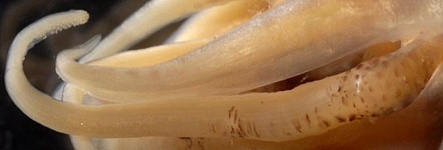
Figure. Tentacular stalk chromatophores from a female P. giardi. ©
- Size. Mature adults range approximately 15-21 mm DGL (Dorsal Gladius Length).
Comments
Further description of P. giardi can be found here.
Comparisons between P. hoylei and P. giardi can be found here.
Life history
Age and reproduction
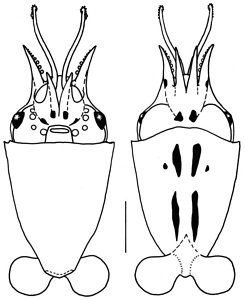
Figure. Ventral view of paralarval P. giardi, 2.9 mm ML, Hawaiian waters. Chromatophores - black; photophores - unfilled circles. Drawing modified from Young, et al., 1992.
Eggs are small (ca. 0.7 mm) but large in comparison to the small size of the spawning females. The oviduct holds only a few eggs (e.g., 11 in a 21 mm ML female). Presumably eggs are spawned in small batches and at frequent intervals due to the small storage capacity. The age at maturity and life-span are unknown.
Paralarvae
Due to similarities in general shape and the large size of the ocular-photophores, paralarvae are more easily confused with those of Pyroteuthis than other species of Pterygioteuthis. They are, however, distinguished from Pyroteuthis paralarvae by:
- The large branchial photophores (equal to or larger than the anal photophores).
- The lack of chromatophores on the tentacles except at the base.
- More highly swollen tentacle base and slender distal tentacle.
Compare with paralarvae of Pterygioteuthis microlampas and Pyroteuthis addolux.
Distribution
Vertical distribution
In Hawaiian waters, this species vertically migrates from upper mesopelagic depths during the day to the upper 50 m at night (Young, 1978). Off Bermuda most captures were from 50-100 m at night while the few daytime captures suggested a depth range of 327-475 m (Roper and Young,1975). In the eastern North Atlantic captures were made mostly at 300-400m during the day and 50-200m at night (Clarke and Lu, 1974).
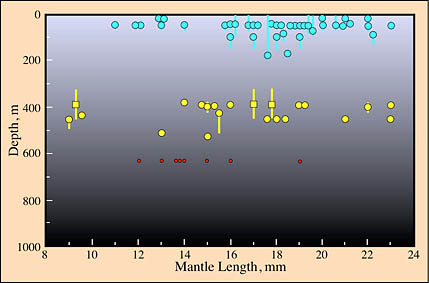
Figure. Vertical distribution chart of P. giardi based on opening/closing trawls and open trawls taken off Hawaii. Yellow dots - Modal depth of trawl, day capture. Blue dots - Modal depth of trawl, night capture. Bars - Depth range of trawl for opening/closing tows. Red dots - Captures from open trawls that are assummed to be contaminants; that is, the squid were captured in an open trawl presumably while the trawl was being set or retreived and not at the modal fishing depth of the trawl. Distribution chart modified from Young, 1978.
Geographical distribution
This species was first described from the North Atlantic off Morocco (Fischer, 1896). It is the most widely distributed member of the Pyroteuthidae.
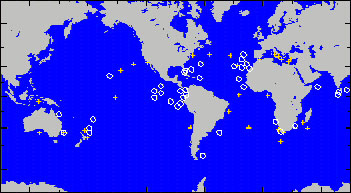
Figure. Map showing some of the general localities (white circles) where P. giardi has been captured. Areas where other pyroteuthids have been captured are indicated by yellow crosses
Geographical variation
Nesis (1982/87) distinguishes two subspecies: P. giardi giardi (Atlantic) and P. giardi hoylei (Indo-Pacific; ) based on differences in the size of the hooks on the right arm IV of males. These forms were first given this taxonomic status by Pfeffer (1912) based on descriptions by Hoyle (1904) of the latter form from the Eastern Equatorial Pacific. A careful study, however, of speciation in this taxa has never been made.
Off Hawaii P. giardi appears to be a facultative mesopelagic-boundary species as it is twice as abundant as P. microlampas over bottom depths of less than 800 m but only 1/5 as abundant as its congener over more oceanic depths (Young, 1995).
References
Fischer, H. 1896. Note préliminaire sur le Pterygioteuthis Giardi, céphalopode nouveau recuelli dans le Cours de l'Expédition scientifique du Talisman (1883). Jour. Conchyliologie 43: 205-211.
Hoyle, W. E. 1904. Reportson the Cephalopoda. Bull. Mus. Comp. Zool., Harvard Coll, Cambridge. 43: 1-72.
Nesis, K. N. 1982. Abridged key to the cephalopod mollusks of the world's ocean. 385+ii pp. Light and Food Industry Publishing House, Moscow. (In Russian.). Translated into English by B. S. Levitov, ed. by L. A. Burgess (1987), Cephalopods of the world. T. F. H. Publications, Neptune City, NJ, 351pp.
Okutani, T. 1974. Epipelagic decapod cephalopods collected by micronekton tows during the EASTROPAC expeditions, 1967-1968 (systematic part). Bull. Tokai Reg. Fish. Res. Lab., 80: 29-118.
Pfeffer, G. 1912. Die Cephalopoden der Plankton-Expedition. Ergebnisse der Plankton-Expedition der Humboldt-Stiftung. 2: 1-815.
Roper, C. F. E. and R. E. Young. 1975. Vertical distribution of pelagic cephalopods. Smithsonian Contributions to Zoolog, 209: 1-51
Young, R. E. 1978. Vertical distribution and photosensitive vesicles of pelagic cephalopods from Hawaiian waters. Fishery Bulletin, 76: 583-615.
Young, R. E. 1995. Aspects of the natural history of pelagic cephalopods of the Hawaiian mesopelagic-boundary region. Pac. Sci. 49: 143-155.
Young, R. E., K. M. Mangold and M. Vecchione (1992). The enoploteuthid group of families. P. 55-66. In: Sweeney, M. J., C. F. E. Roper, K. M. Mangold, M. R. Clarke and S. V. Boletzky (eds.). "Larval" and juvenile cephalopods: a manual for their identification. Smithson. Contr. Zool., No. 513: 1-282.
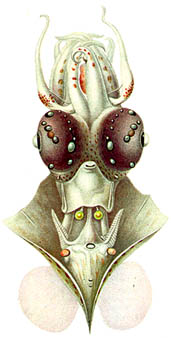
Title Illustrations

| Scientific Name | Pterygioteuthis giardi |
|---|---|
| Comments | mantle cut open to show photophore pattern |
| Reference | from Chun, C. 1910. Die Cephalopoden. Oegopsida. Wissenschaftliche Ergebnisse der Deutschen Tiefsee-Expedition, "Valdivia" 1898-1899, 18: 1-522 + Atlas. |
| Sex | Male |

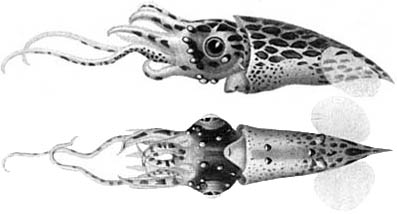
| Scientific Name | Pterygioteuthis giardi |
|---|---|
| Reference | from Chun, C. 1910. Die Cephalopoden. Oegopsida. Wissenschaftliche Ergebnisse der Deutschen Tiefsee-Expedition, "Valdivia" 1898-1899, 18: 1-522 + Atlas. |
| View | lateral, ventral |
About This Page

Ohio State University, Columbus, Ohio, USA
University of Hawaii, Honolulu, HI, USA
Katharina M. Mangold (1922-2003)
Laboratoire Arago, Banyuls-Sur-Mer, France
Correspondence regarding this page should be directed to Annie Lindgren at
Page copyright © 2016 and
All Rights Reserved.
- Content changed 16 November 2016
Citing this page:
Lindgren, Annie, Richard E. Young, and Katharina M. Mangold (1922-2003). 2016. Pterygioteuthis giardi . Version 16 November 2016 (under construction). http://tolweb.org/Pterygioteuthis_giardi/19751/2016.11.16 in The Tree of Life Web Project, http://tolweb.org/


