We compare just three species; paralarvae of other species in the family are unknown or inadequately known.
The distinctive features of Pyroteuthis addolux are:
- Relatively small branchial photophores (smaller than anal photophores); absent at < 4mm ML;
- A series of chromatophores on distal portion of tentacle (see arrow in drawing). Unfortunately these are easily lost due to damage during capture.
- Large ocular photophores.
- Few chromatophores on mantle.
The distinctive features of Pterygioteuthis giardi are:
- Large branchial photophores (equal to or larger than anal photophores); absent at < 1.5 mm ML.
- Absence of chromatophores on distal portion of tentacle.
- Large ocular photophores.
- Few chromatophores on mantle.
- Relatively thicker tentacle base and more slender distal tentacle.
The distinctive features of Pterygioteuthis microlampas are:
- Large branchial photophores (equal to or larger than anal photophores); absent at < 1.5 mm ML.
- Single, large, dark chromatophore on distal portion of tentacle (i.e., at base of club, see arrow).
- Small ocular photophores.
- Numerous chromatophores on the mantle.
- Pair of chromatophores on the ventral surface of the funnel (see arrow; present only in advanced paralarvae; colored grey in the illustration to indicate its location beneath the mantle).

Click on an image to view larger version & data in a new window
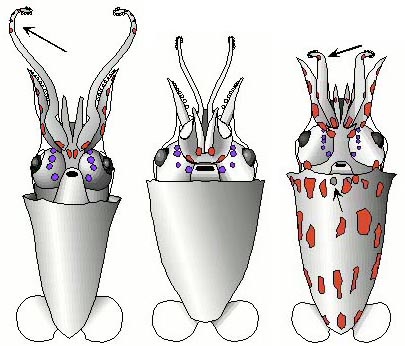
Figure. Left - Pyroteuthis addolux. Middle - Pterygioteuthis giardi. Right - Pterygioteuthis microlampas. All paralarvae illustrated are 2.9 mm ML. Arrows indicate location of some of the chromatophores whose presence is diagonostic at the species or generic level. Drawings modified from Young et al., 1992.


