


Enoploteuthis higginsi
Kotaro Tsuchiya and Richard E. Young
Introduction
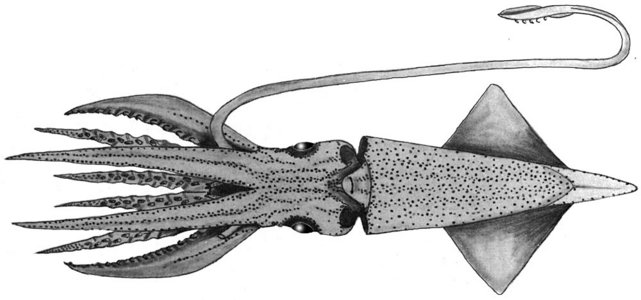
Enoploteuthis higginsi, a relatively small-sized species for the genus, attains 70mm DML. This species resembles the sympatrically occurring species E. jonesi, but is separable by the large numbers and relatively diffuse arrangement of integumental photophores on the mantle and head. E. higginsi is also similar to E. anapsis from the Atlantic Ocean in the photophore patterns.
Characteristics
- Tentacle
- Tentacle long, with distinct club.
- Carpal cluster oval.
- Two rows of different-sized hooks on manus.
- Four rows of suckers on dactylus.
Click on an image to view larger version & data in a new window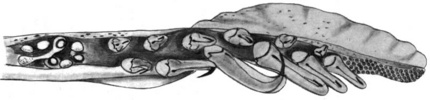
Figure. Oral view of the tentacular club of E. higginsi, female, 45 mm ML, Hawaiian waters. Drawing from Burgess (1982).
- Hectocotylus
- Hectocotylus with large truncate membranous flap on the ventral edge and small semilunar one on the dorso-distal edge.
- Modified portion partially lacks armature.
Click on an image to view larger version & data in a new window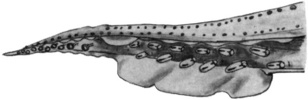
Figure. Oral view of the tip of the hectocotylized right arm IV of E. higginsi, male, 37 mm ML, Hawaiian waters. Drawing from Burgess (1982).
- Head
- Beaks: Descriptions can be found here: Lower beak; upper beak.
- Beaks: Descriptions can be found here: Lower beak; upper beak.
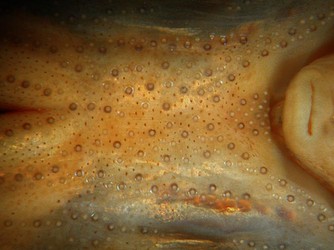
- Integumental Photophores
- Ventral mantle with six, obscure, longitudinal stripes of integumental organs; scattered intermediate organs occur between stripes.
- Ventral head with four longitudinal stripes of integumental organs that are interconnected at each end forming a ring-like pattern; in mature specimens, photophore arrangement almost diffuse.
- Ventral side of arm III with a series of organs on the proximal half of the arm at the base of aboral keel.
Comments
This speceis closely resembles E. jonesi in most taxonomical characters. It is separable from E. jonesi by the large numbers of integumental photophores on the ventral head and mantle. In E. jonesi, each photophore stripe on head is formed by a single row of organs rather than the multiple rows of E. higginsi.
Life history
Eggs
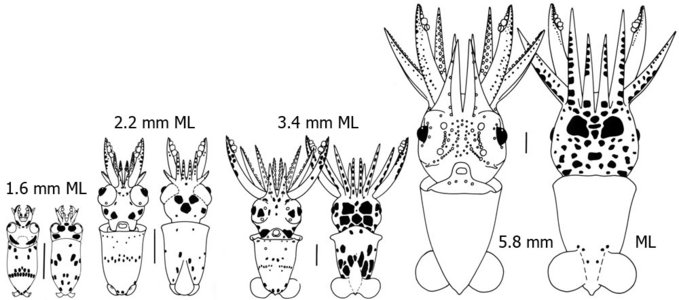
Eggs in early organogenesis stage having a large diagnostic pigment spot are 0.9 mm x 0.8 mm.Paralarva
Paralarva of present species is characterized by:- Tentacular club short, and bearing few very large suckers.
- Mantle short, large head, arms short, tentacles thick.
Distribution
Vertical distribution
Vertical distribution of paralarva shows a peak at 100-150m during both day and night in Hawaiian waters (Young and Harman, 1985).
Geographical distribution
This species is widely distributed in equatorial Pacific waters from the Northwest Pacific and Hawaii, to the Coral Sea (Burgess, 1982; Tsuchiya, 1993).
References
Burgess, L.A. 1982. Four new species of squid (Oegopsida: Enoploteuthis) from the central Pacific and a description of adult Enoploteuthis reticulata. Fishery Bulletin, 80(4):703-734, 7 figures.
Young, R. E. and R. Harman. 1985. Early life history stages of enoploteuthin squids (Cephalopoda, Teuthoidea, Enoploteuthidae) from Hawaiian waters. Vie et Milieu, 35: 181-202.
Tsuchiya, K. 1993. Distribution and zoogeography of the family Enoploteuthidae in the Northwest Pacific. In: Okutani, T., O’Dor, R. K. and Kubodera, T. (eds.) 1993. Recent advances in fisheries biology (Tokai University Press. Tokyo). pp. 571-585.
Title Illustrations
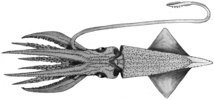
| Scientific Name | Enoploteuthis higginsi |
|---|---|
| Location | Hawaiian waters at 21°N, 158°W |
| Creator | L. Burgess |
| Sex | Female |
| View | Ventral |
| Size | 45 mm ML |
| Type | Paratype |
About This Page

Tokyo University of Fisheries, Tokyo, Japan
University of Hawaii, Honolulu, HI, USA
Page copyright © 2015 and
 Page: Tree of Life
Enoploteuthis higginsi .
Authored by
Kotaro Tsuchiya and Richard E. Young.
The TEXT of this page is licensed under the
Creative Commons Attribution-NonCommercial License - Version 3.0. Note that images and other media
featured on this page are each governed by their own license, and they may or may not be available
for reuse. Click on an image or a media link to access the media data window, which provides the
relevant licensing information. For the general terms and conditions of ToL material reuse and
redistribution, please see the Tree of Life Copyright
Policies.
Page: Tree of Life
Enoploteuthis higginsi .
Authored by
Kotaro Tsuchiya and Richard E. Young.
The TEXT of this page is licensed under the
Creative Commons Attribution-NonCommercial License - Version 3.0. Note that images and other media
featured on this page are each governed by their own license, and they may or may not be available
for reuse. Click on an image or a media link to access the media data window, which provides the
relevant licensing information. For the general terms and conditions of ToL material reuse and
redistribution, please see the Tree of Life Copyright
Policies.
- Content changed 21 January 2014
Citing this page:
Tsuchiya, Kotaro and Richard E. Young. 2014. Enoploteuthis higginsi . Version 21 January 2014 (under construction). http://tolweb.org/Enoploteuthis_higginsi/19708/2014.01.21 in The Tree of Life Web Project, http://tolweb.org/


