


Enoploteuthis reticulata
Kotaro Tsuchiya and Richard E. Young
Introduction
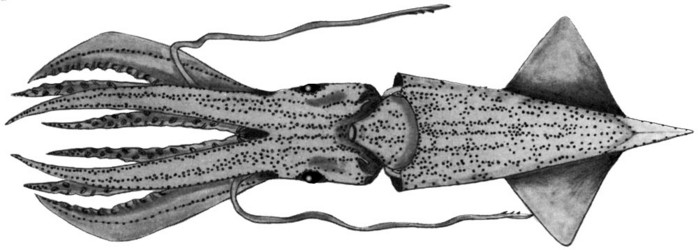
Enoploteuthis reticulata, a large species for the family, attains 130mm DML. It was first described from the stomach of a lancetfish in the Indonesian waters, and is broadly distributed in the Indo-West Pacific.
Brief diagnosis:
An Enoploteuthis (Enoploteuthis) with...
- longitudinal and oblique rows of photophores on ventral mantle giving reticulate pattern.
Characteristics
- Hectocotylus
- Hectocotylus with large truncate membranous flap on ventral edge.
- Modified portion with armature.
Click on an image to view larger version & data in a new window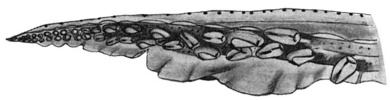
Figure. Oral view of the tip of the hectocotylized right arm IV of E. reticulata, male, 71 mm ML, Hawaiian waters. Drawing from Burgess (1982).
- Tentacle
- Tentacle short, narrow.
- Carpal cluster elongate.
- Two rows of subequal-sized hooks on manus.
- Two rows of suckers on dactylus.
Click on an image to view larger version & data in a new window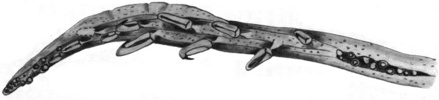
Figure. Oral view of the tentacular club of E. reticulata, male, 117 mm ML, Hawaiian waters. Drawing from Burgess (1982).
- Head
- Beaks: Descriptions can be found here: Lower beak; upper beak.
- Beaks: Descriptions can be found here: Lower beak; upper beak.
- Integumental Photophores
- Ventral mantle with six longitudinal stripes of integumental organs, that are connected with oblique stripes to form latter-like pattern.
- Ventral head with four longitudinal stripes of integumental organs which connected in each side forming ring-like.
- Ventral side of arm III with a row of organs along almost entire length.
Life history
Eggs
Spawned eggs are ovoid, 1.08 x 0.78 mm, colorless, slightly opaque with a slightly dull, silvery chorion.
Paralarva
Paralarvae are distinguished by their numerous head and mantle chromatophores.
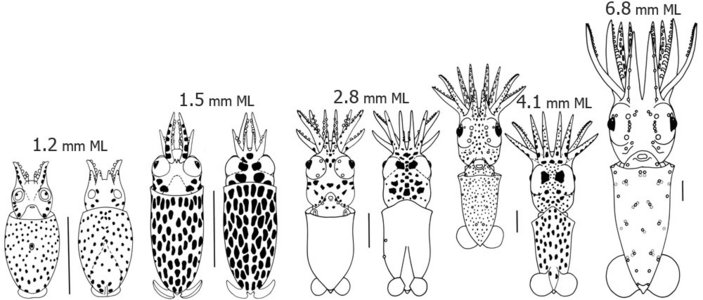
Figure. Ventral and dorsal views of paralarvae of E. reticulata and a ventral view of an early juvenile, Hawaiian waters. Drawings from Young and Harman (1985).
Juveniles
The following illustrations show the characteristic photophore patterns seen on the ventral mantle during development.
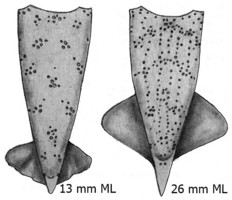
Figure. Ventral views of the mantles of two young E. reticulata.Drawings from Burgess (1982, p. 709, Fig. 2a,b).
Predators
E. reticulata is common item in the stomachs of lancetfish, Alepisaurus ferox, and bigeye tuna, Thunnus obesus, in the Indo-Pacific (Okutani and Tsukada, 1981; Moteki et al, 1993).
Distribution
Vertical distribution
Paralarvae were captured in the upper 200m (Young and Harman, 1985).
Geographical distribution
This species was first described from New Guinean waters. It is distributed widely in the tropical Indo-Pacific.References
Burgess, L.A. 1982. Four new species of squid (Oegopsida: Enoploteuthis) from the central Pacific and a description of adult Enoploteuthis reticulata. Fishery Bulletin, 80(4):703-734.
Moteki, M., Fujita, K., Kohno, H., 1993. Stomach contents of longnoselancetfish, Alepisaurus ferox, in Hawaiian and central equatorial Pacific waters. J. Tokyo Univ. Fish. 80, 121–137.
Okutani, T. 1974. Epipelagic decapod cephalopods collected by micronekton tows during the EASTROPAC expeditions, 1967-1968 (systematic part). Bull. Tokai Reg. Fish. Res. Lab., 80: 29-118.
Tsuchiya, K. 2000. Illustrated book of the Enoploteuthidae. In: Okutani T., ed. True face of Watasenia scintillans. Tokai University Press, Tokyo, p 196–269. (in Japanese)
Young, R. E. and R. Harman. 1985. Early life history stages of enoploteuthin squids (Cephalopoda, Teuthoidea, Enoploteuthidae) from Hawaiian waters. Vie et Milieu, 35: 181-202.
Title Illustrations

| Scientific Name | Enoploteuthis reticulata |
|---|---|
| Location | Hawaiian waters |
| Reference | Burgess, L.A. 1982. Four new species of squid (Oegopsida: Enoploteuthis) from the central Pacific and a description of adult Enoploteuthis reticulata. Fishery Bulletin, 80(4):703-734. P. 709, Fig. Ba,b. |
| Creator | L. Burgess |
| Sex | Female |
| View | Ventral |
| Size | 62 mm ML |
About This Page

Tokyo University of Fisheries, Tokyo, Japan
University of Hawaii, Honolulu, HI, USA
Page copyright © 2015 and
 Page: Tree of Life
Enoploteuthis reticulata .
Authored by
Kotaro Tsuchiya and Richard E. Young.
The TEXT of this page is licensed under the
Creative Commons Attribution-NonCommercial License - Version 3.0. Note that images and other media
featured on this page are each governed by their own license, and they may or may not be available
for reuse. Click on an image or a media link to access the media data window, which provides the
relevant licensing information. For the general terms and conditions of ToL material reuse and
redistribution, please see the Tree of Life Copyright
Policies.
Page: Tree of Life
Enoploteuthis reticulata .
Authored by
Kotaro Tsuchiya and Richard E. Young.
The TEXT of this page is licensed under the
Creative Commons Attribution-NonCommercial License - Version 3.0. Note that images and other media
featured on this page are each governed by their own license, and they may or may not be available
for reuse. Click on an image or a media link to access the media data window, which provides the
relevant licensing information. For the general terms and conditions of ToL material reuse and
redistribution, please see the Tree of Life Copyright
Policies.
- Content changed 10 November 2012
Citing this page:
Tsuchiya, Kotaro and Richard E. Young. 2012. Enoploteuthis reticulata . Version 10 November 2012 (under construction). http://tolweb.org/Enoploteuthis_reticulata/19713/2012.11.10 in The Tree of Life Web Project, http://tolweb.org/


