


Ommastrephidae
Richard E. Young, Michael Vecchione, and Martina A. Compagno Roeleveld (ca. 1946-2006)
This family is generally divided into three subfamilies and eleven genera that contain 22 species.


This tree diagram shows the relationships between several groups of organisms.
The root of the current tree connects the organisms featured in this tree to their containing group and the rest of the Tree of Life. The basal branching point in the tree represents the ancestor of the other groups in the tree. This ancestor diversified over time into several descendent subgroups, which are represented as internal nodes and terminal taxa to the right.
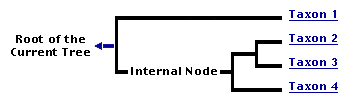
You can click on the root to travel down the Tree of Life all the way to the root of all Life, and you can click on the names of descendent subgroups to travel up the Tree of Life all the way to individual species.
For more information on ToL tree formatting, please see Interpreting the Tree or Classification. To learn more about phylogenetic trees, please visit our Phylogenetic Biology pages.
close boxIntroduction
Members of the Ommastrephidae are small (about 10 cm ML) to large (about 100 cm ML), muscular squids that are often the dominant large squids in oceanic and, occasionally, neritic waters. A number of species are fished commercially.
Ommastrephid squids are among the strongest swimmers in the Cephalopoda. Some are commonly known as "flying squid" due to their ability to glide over the ocean surface as seen in the photographs.
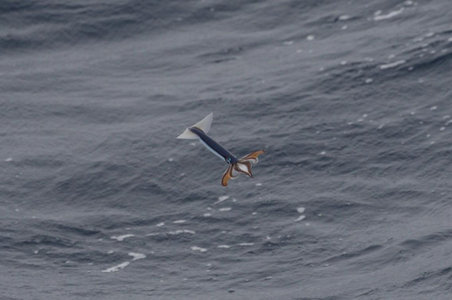
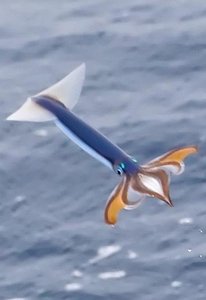
Figure. A squid, presumably Ommastrephes bartramii, gliding over the sea surface near Japan. Left - The original photograph by Geoff Jones. Right - Enlarged and enhanced (by Geoff Jones) reproduction of the squid. Note the spread fins and the spread arms with extended membranes that apparently aid gliding. © Geoff Jones
Brief diagnosis
An oegopsid squid ...
- with an inverted T-shaped funnel/mantle locking-apparatus.
- with fused tentacles in paralarvae.
Characteristics
- Funnel/mantle locking-apparatus with an inverted T-shape. Click on an image to view larger version & data in a new window
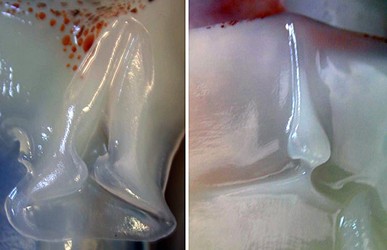
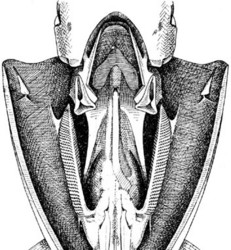
Figure. Frontal views of the funnel/mantle locking apparatus. Left - Funnel component of Illex illecebrosus. Middle - Mantle component of Illex illecebrosus. Photographs by M. Vecchione. Right - Opened mantle cavity showing the funnel/mantle locking apparatus of Todaropsis eblanae. Drawing from Naef (1921-23).
Comparisons of the funnel/mantle locking-apparatus between genera can be found here.
- Funnel adductor muscles
- Thick external funnel-adductor muscles connect lateral edges of funnel with head near its ventral surface. [These muscles are not homologous with the more superficial lateral adductor muscles of the Sepioidea.] Click on an image to view larger version & data in a new window
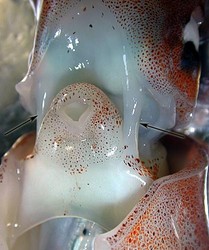
Figure. Ventral view of the funnel of Illex illecebrosus showing the strong lateral adductor muscles (arrows). These muscles are also seen in the drawing of Todaropsis eblanae above. Photograph by M. Vecchione.
- Thick external funnel-adductor muscles connect lateral edges of funnel with head near its ventral surface. [These muscles are not homologous with the more superficial lateral adductor muscles of the Sepioidea.]
- The typical structure of a tentacle-club can be seen here.
- Paralarvae (rhynchoteuthion stage) with fused tentacles (=proboscis).
The proboscis begins to split at the base usually around 3-4 mm ML. The split gradually increases until the proboscis has split completely in half to form the two tentacles at about 7-10 mm ML. The proboscis increases in size as the paralarva grows but at about 6 mm ML the proboscis begins to shrink in absolute size until the tentacles are formed. The small newly formed tentacles appear to be initially non-functional (poorly formed suckers) but grow rapidly (see Wakabayashi et al., 2002).
Click on an image to view larger version & data in a new window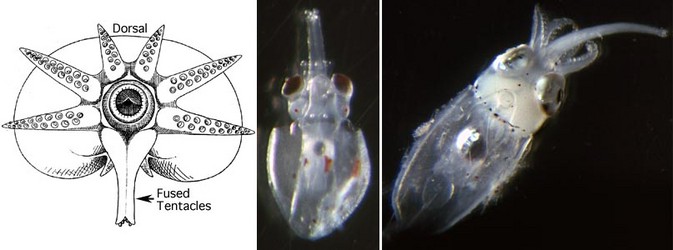
Figure. Rhynchoteuthion paralarvae. Left - Oral view, species unknown. Drawing modified from Naef (1921-23). Middle -Ventral view of Ommastrephes bartramii, 4 days old, living. Photograph by Y. Sakurai. Right - Ventral view of Sthenoteuthis oualaniensis, advanced, fresh. Photograph by R. Young.
- Arms with biserial suckers.
- Tentacular clubs with quadraserial suckers (club dactylus with eight sucker series in Illex).
- Buccal connectives attach to dorsal borders of Arms IV.
- Distinctive, slender gladius with primary conus. Click on an image to view larger version & data in a new window

Figure. Ventral view of the gladius of Todarodes sagittatus, immature, 120 mm ML. Drawing from Naef (1921-23).
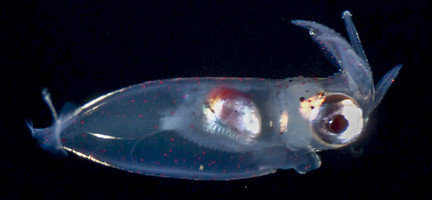
Figure. Rhynchoteuthion paralarva, probably Sthenoteuthis oualaniensis about 6-8 mm ML, photographed in situ off Hawaii Island. Note the nearly vertical position of the proboscis. © 2016 Jeffrey Milisen
Comparison of subfamilies:
| Photophores present1 | Dactylus suckers | Funnel- groove foveola3 | Funnel- groove side pockets3 | Distal protective membranes on hectocotylus | Carpal locking apparatus2 | |
| Illicinae | No | 8 series | No | No | Absent | Absent |
|---|---|---|---|---|---|---|
| Ommastrephinae | Yes | 4 series | Yes | Yes | Ventral membrane enlarged subdistally | Present except Ornithoteuthis |
| Todarodinae | No | 4 series | Yes/No | No | Ventral membrane with thickened trabeculae | Absent |
- 1Photophores difficult to detect in some species.
- 2Defined as presence of knobs and corresponding suckers with smooth sucker rings.
- 3Funnel grooves in Todarodinae and Ommastrephinae: Click on an image to view larger version & data in a new window
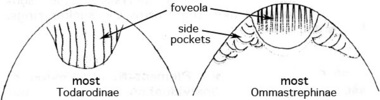
Figure. Ventral view of the funnel groove comparing modifications in two of the subfamilies. Drawing modified from Roper, et al. (1985).
Nomenclature
A list of all nominal genera and species in the Ommastrephidae can be found here. The list includes the current status and type species of all genera, and the current status, type repository and type locality of all species and all pertinent references.
Discussion of Phylogenetic Relationships
Although the family is very well characterized, placement of species with genera and subfamilies has, in some cases, been controversial. These controversies have often revolved around the importance of absence of a character (e. g., absence of foveola and side pockets from the funnel groove of Todaropsis, a feature shared with Illex) which, without adequate polarization, could be interpreted as a synapomorphy, a symplesiomorphy, or a convergent loss.
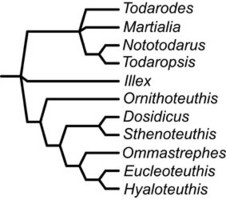
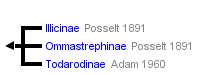
Figure. Phylogenetic tree of the Ommastrephidae. The three basal branches represent the three subfamilies. Figure based on Roeleveld (1988).
The relationships presented here are from the phylogenetic study by Roeleveld (1988). The relationships are based on a number of different structures but rely heavily on the structure of the hectocotylus. The lack of known relationships among outgroups makes rooting of the tree difficult. Not all workers agree with the subfamial placement of genera (e.g. Nesis, 1982/7; Wormuth, et al., 1998). The latter authors place Todaropsis next to Illex in the Illicinae.
A more recent study based on molecular analyses (Wakabayashi, et al., 2012) supported the presence of the three subfamilies but placed Ornithoteuthis in the Todarodinae and questioned the generic relationships within the subfamilies and the placement of Todarodes pacificus in Todarodes.
References
Nesis, K. N. 1982. Abridged key to the cephalopod mollusks of the world's ocean. 385+ii pp. Light and Food Industry Publishing House, Moscow. (In Russian.). Translated into English by B. S. Levitov, ed. by L. A. Burgess (1987), Cephalopods of the world. T. F. H. Publications, Neptune City, NJ, 351pp.
Roeleveld, M. A. 1988. Generic interrelationships within the Ommastrephidae (Cephalopoda). P.277-314. In: M. R. Clarke and E. R. Trueman (eds.). The Mollusca. Vol. 12. Paleontology and Neontology of Cephalopods. Academic Press, N.Y., 355pp.
Wakabayashi, T., K. Saito, K. Tsuchiya and S. Segawa. 2002. Descriptions of Eucleoteuthis luminosa (Sasaki, 1915) and Ornithoteuthis volatilis (Sasaki, 1915) paralarvae in the Northwestern Pacific. Venus, 60 (4): 237-260.
Wakabayashi, T., N. Suzuki, M. Sakai, T. Ichii and S. Chow. Phylogenetic relationships among the family Ommastrephidae (Mollusca: Cephalopoda) inferred from two mitochondrial DNA gene sequences. Marine Genomics 7 (2012) 11–16
Wormuth, J. 1998 Workshop deliberations on the Ommastrephidae; a brief history of their systematics; and a review of the systematics, distribution and biology of the genera Martialia Rochebrune and Mabille, 1889, Todaropsis Girard, 1890, Dosidicus Steenstrup, 1857, Hyaloteuthis Gray, 1849, and Eucleoteuthis Berry, 1916. Smithson. Contr. Zool., No. 586:373-384..
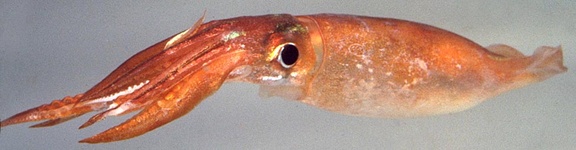
Title Illustrations

| Scientific Name | Nototodarus hawaiiensis |
|---|---|
| Location | Hawaiian waters |
| Creator | Ray Hixon |
| Specimen Condition | Live Specimen |
| Behavior | Resting on bottom of aquarium |
| View | Side |
| Copyright |
©

|

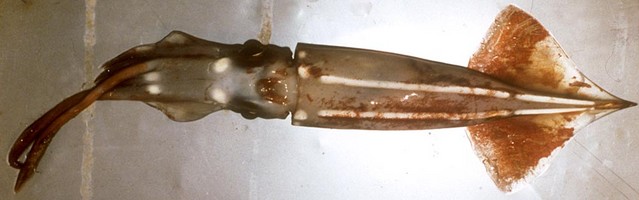
| Scientific Name | Eucleoteuthis luminosa |
|---|---|
| Location | off Hawaii |
| Image Use |
 This media file is licensed under the Creative Commons Attribution-NonCommercial License - Version 3.0. This media file is licensed under the Creative Commons Attribution-NonCommercial License - Version 3.0.
|
| Copyright |
© 1996
|
About This Page
University of Hawaii, Honolulu, HI, USA
National Museum of Natural History, Washington, D. C. , USA
Martina A. Compagno Roeleveld (ca. 1946-2006)
South African Museum, Cape Town, South Africa
Page copyright © 2019 , , and Martina A. Compagno Roeleveld (ca. 1946-2006)
 Page: Tree of Life
Ommastrephidae .
Authored by
Richard E. Young, Michael Vecchione, and Martina A. Compagno Roeleveld (ca. 1946-2006).
The TEXT of this page is licensed under the
Creative Commons Attribution-NonCommercial License - Version 3.0. Note that images and other media
featured on this page are each governed by their own license, and they may or may not be available
for reuse. Click on an image or a media link to access the media data window, which provides the
relevant licensing information. For the general terms and conditions of ToL material reuse and
redistribution, please see the Tree of Life Copyright
Policies.
Page: Tree of Life
Ommastrephidae .
Authored by
Richard E. Young, Michael Vecchione, and Martina A. Compagno Roeleveld (ca. 1946-2006).
The TEXT of this page is licensed under the
Creative Commons Attribution-NonCommercial License - Version 3.0. Note that images and other media
featured on this page are each governed by their own license, and they may or may not be available
for reuse. Click on an image or a media link to access the media data window, which provides the
relevant licensing information. For the general terms and conditions of ToL material reuse and
redistribution, please see the Tree of Life Copyright
Policies.
- Content changed 16 November 2016
Citing this page:
Young, Richard E., Michael Vecchione, and Martina A. Compagno Roeleveld (ca. 1946-2006). 2016. Ommastrephidae . Version 16 November 2016. http://tolweb.org/Ommastrephidae/19418/2016.11.16 in The Tree of Life Web Project, http://tolweb.org/

